Guides / Materials
Acetal Rod, Plate and Tube: Typical Stock Sizes, Tolerances and How to Pick
October 9, 2026
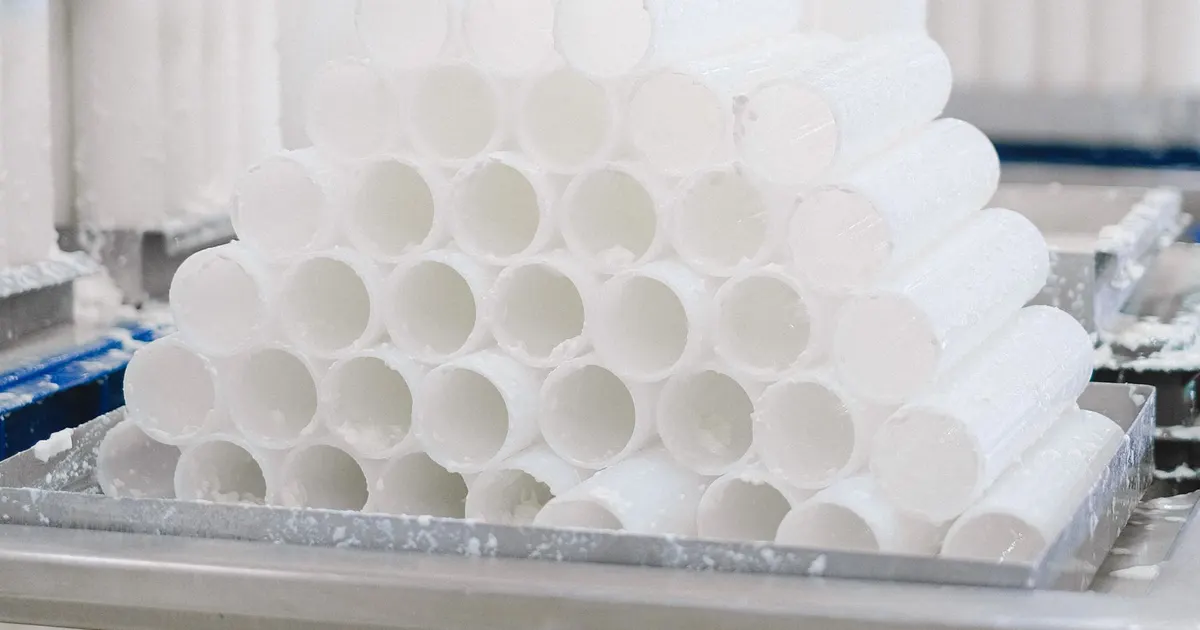
Almost every machined acetal part starts as a standard stock shape: a rod, a sheet or a tube. The stock size decides how much material is removed, how much waste there is and how long the job takes to start. A design that fits a common stock size is cheaper and faster than one that needs a special order.
How acetal stock is made
Most acetal rod, sheet and tube is made by extrusion. Molten resin is pushed through a die and cooled, and the cooling rate sets the structure. Large diameters and thick sections cool slowly in the middle, so they have more residual stress and sometimes a small void along the centre line. Cast and compression-moulded forms exist for very large sizes. The material properties guide explains how the grades differ.
Stock comes as homopolymer or copolymer, and in natural, black and a few other colours. See the copolymer versus homopolymer guide for how the choice affects machining and the final part.
Typical size ranges
| Form | Typical range stocked | Common form |
|---|---|---|
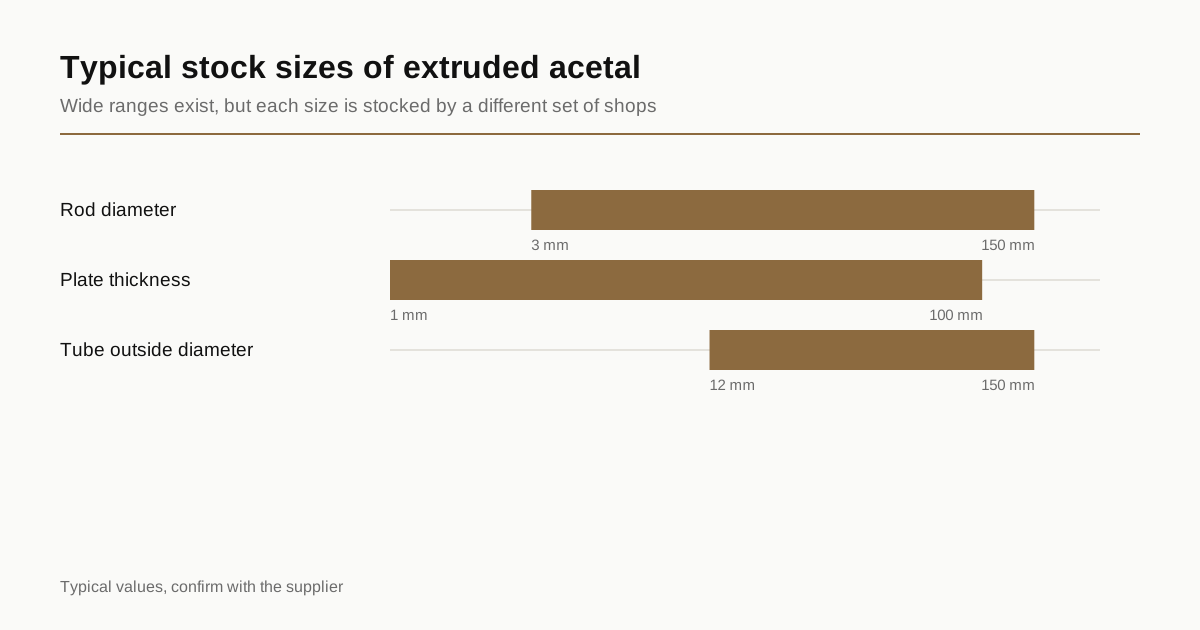
| Rod | About 3 to 150 mm diameter | 1 m or 3 m lengths |
| Sheet and plate | About 1 to 100 mm thick | 1000 x 2000 mm and similar |
| Tube | About 12 to 150 mm outside diameter | Limited wall choices |
| Square and flat bar | Several widths and thicknesses | Cut from sheet or extruded |
These ranges are typical and each supplier stocks a subset. Ranges overlap in the middle, and extremes at both ends take longer to get. Imperial sizes are stocked widely in North America, and metric in Europe and Asia, so a drawing in one system may be cheaper to source in the other if the part tolerates a small size change.
Tolerances on stock
Extruded stock is held to commercial tolerances, much looser than a machined part. The values depend on the maker and the size, and these are typical patterns:
| Item | Typical pattern |
|---|---|
| Rod diameter | Oversize by a fraction of a millimetre up to a few millimetres, with a wider spread on larger diameters |
| Rod roundness | Slightly out of round, more on large diameters |
| Sheet thickness | A percentage of nominal, often wider on thin sheet in relative terms |
| Sheet flatness | Some bow, more on large, thin sheets |
| Tube wall | Wall thickness and concentricity vary |
Precision-ground or centreless-ground rod is held much tighter and is used for small, automated turning, such as on a Swiss lathe. See the Swiss turning guide. Ask the supplier for the tolerance on the size you need rather than relying on a table.
What oversize means for machining
Because stock is oversize, there is always material to remove. For a turned part, a rod 1 to 3 mm over the finished diameter gives enough to clean up the skin. For a milled part, a sheet a few millimetres thicker than the finished thickness lets both faces be machined flat.
Design around this:
- Pick the nearest stock size above the finished diameter. A 40 mm part from 45 mm rod wastes more than one from 42 mm rod.
- Check availability. Common sizes are stocked at many shops. An unusual size can double the wait.
- Plan for clean-up on both faces of sheet. If you want a 10 mm plate flat on both sides, start from 12 mm.
- Use the skin. If the stock surface is acceptable, leaving it on saves time, but only where tolerance and finish allow.
The oversize adds to the cost and the lead time. See the cost guide and the lead time guide.
Residual stress and large sections
Thick plate and large rod carry stress that is released as material is cut away. A part machined from the centre of a thick plate behaves differently from one cut from the edge. The bigger the section and the thinner the finished part, the more it moves. The annealing guide covers stress relief, and the flatness guide shows how to hold a plate that wants to bow.
For large rods, shops sometimes use a hollow starting shape or cut the part in two stages to relieve stress. For critical parts, ask whether the stock is annealed from the maker or needs an extra step.
Void along the centre of rod
Large extruded rod can have a tiny pore or hollow along the centre line, from shrinkage as the core cools. It is usually harmless for non-critical parts but can show up when a bore is cut through the centre or when the part is a pressure or sealing component. Natural rod shows it more easily when cut. For critical parts, ask the supplier whether a stock form with a controlled core is offered, and cut a test slice from the bar before committing.
Tube versus bored rod
| Approach | Strengths | Weaknesses |
|---|---|---|
| Buy tube | Less waste, faster | Limited sizes, concentricity varies |
| Bore rod | Both diameters controlled, wide size choice | More material removed, more machine time |
| Bore thick-wall tube | Compromise | Availability |
For bushings and sleeves, boring rod is common because the inside and the outside both need to be concentric and the wall controlled. A tube with a close wall can save a lot of material if one is stocked in the right size.
Designing to stock
Small changes to a drawing can open up the stock list:
- Move a diameter to the nearest common size when the function allows.
- Allow the shop to choose between homopolymer and copolymer.
- Accept natural or black.
- State a maximum overall length, not an exact bar length, so the shop can cut from standard lengths.
- Say if substitution with imperial or metric stock is acceptable.
For the full list of items to include in a request, see the RFQ checklist.
Ordering stock for a first run
Stock is bought in lengths and sheets, so waste is part of every job. For a first run, a shop usually works out how many parts fit in a bar or a sheet, and orders accordingly. A few points help the estimate:
| Item | What to consider |
|---|---|
| Bar length | Parts per bar after allowing for parting and a gripped end, usually 20 to 50 mm of waste per bar |
| Sheet nesting | Part outlines plus saw or cutter width and clean-up allowance |
| Spare material | A small allowance for setup scrap and a failed first part |
| Minimum order | Some suppliers sell only full bars or sheets, which affects small orders |
| Offcuts | Useful for later small parts, if stored with the lot number |
For a prototype order of a few parts, stock cost can exceed machining cost, because a full bar or a cut piece is bought for a handful of parts. Asking whether the shop already holds the size can cut cost and lead time. If a part can be made from a size already on the shelf, say so in the request. The cost guide shows how material, setup and machine time share a quote.
Checklist before you request a quote
- Give the finished size and say how much oversize is acceptable.
- State the grade, colour and any substitution allowed.
- Note a stress-critical or void-critical requirement.
- Say if ground rod is needed.
- State the quantity so the shop can decide on whole lengths or cut pieces.
Send the drawing and we match it with up to three shops that machine acetal and reply within 24 business hours.
Frequently asked questions
What diameters does acetal rod come in?
Extruded rod is commonly stocked from about 3 mm up to around 150 mm in metric steps and equivalent inch sizes, with larger diameters available as cast or special order. The common sizes are held by many suppliers, while unusual sizes mean a longer wait.
Why is acetal stock supplied oversize?
Extruded plastic stock is not held to machined tolerances, and it carries a skin and a little residual stress. Supplying it slightly oversize leaves material to clean up, so the finished part is the size on the drawing.
Can I buy acetal tube?
Tube is available in a more limited range than rod. Many hollow parts are made by boring rod instead, which gives control of both diameters but wastes more material.
Need a quote for this part?
Send the drawing. We match you with up to 3 shops that machine acetal and reply within 24 business hours.
Get matched with a Delrin shop