Guides / Design
Designing Machined Acetal Gears That Survive the Mesh
September 21, 2026
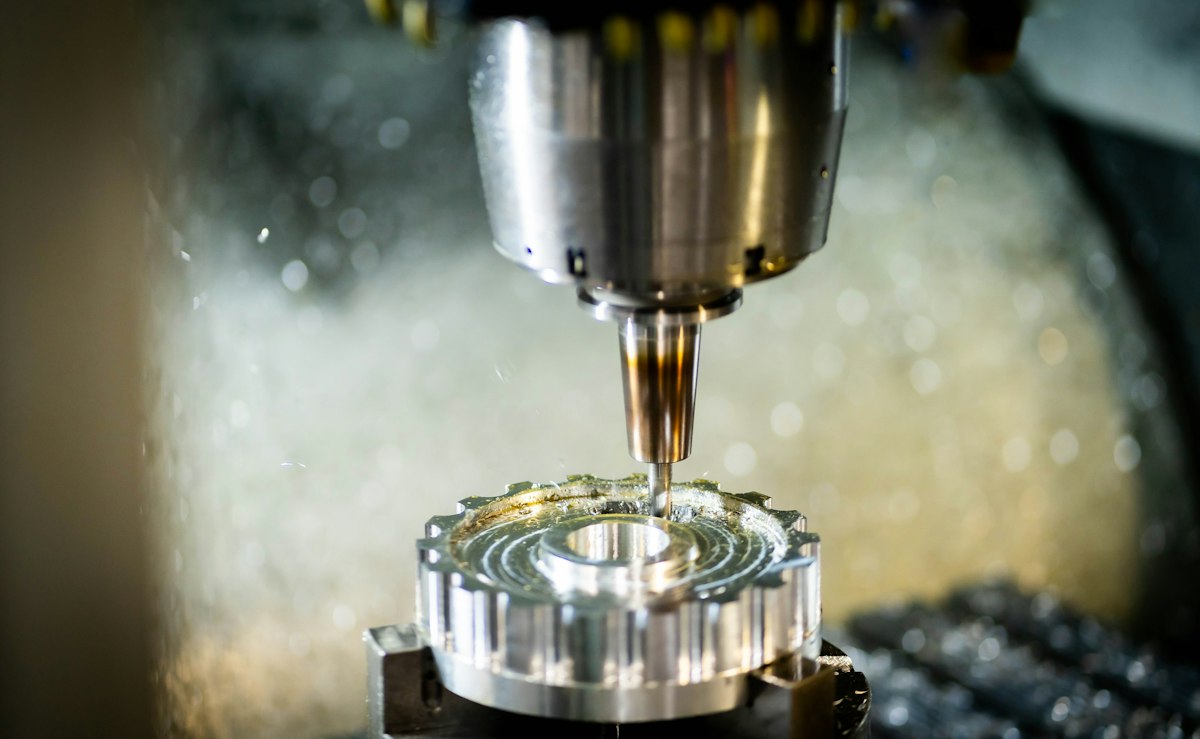
Acetal gears are everywhere in small drives, and most of the ones that fail early fail for two reasons: the backlash was calculated like a metal gear, or the mesh was plastic against plastic. Both are design decisions, not machining ones.
Why acetal rather than nylon
Both are used. Acetal wins when the mesh has to stay put.
Nylon absorbs between 1.5 and 8.5 percent water depending on grade and humidity, and grows as it does. On a gear that changes the tooth thickness and the effective centre distance. In a humid plant a nylon gear that meshed correctly in the shop can bind.
Acetal takes up roughly 0.2 percent in 24 hours. It is also stiffer, which means the tooth deflects less under load, and it resists fatigue better, which matters because every tooth is loaded and unloaded on every revolution.
Nylon keeps an advantage where shock loading is present, because absorbed moisture raises its toughness. A gear train that sees a jam or a sudden reversal may be better in nylon despite the growth.
Backlash
This is the number people get wrong.
Thermal expansion for acetal is near 110 micrometres per metre per kelvin, roughly ten times steel. A gear pair that meshes correctly at 20 degrees C in an enclosure that runs at 55 will have significantly less clearance at temperature, because the acetal grows faster than the steel housing holding the centres.
Work the calculation at the top of the service temperature range. Add a small allowance for moisture. Then check that the resulting backlash at the bottom of the range is still acceptable for positional accuracy.
A gear that binds hot is a gear that was toleranced cold.
Tooth load and module
Plastic teeth carry far less than steel teeth. Practical consequences:
- Use a larger module than you would in steel for the same torque
- Wider face width spreads the load, up to the point where alignment becomes the limit
- Avoid very low tooth counts, undercut teeth are weak at the root in a material that is already notch sensitive
- Generous root fillets, because the root is where fatigue cracks start
Running against steel
Acetal against steel is the well proven pairing. The steel conducts heat away from the mesh and the friction coefficient is low and consistent.
Acetal against acetal traps heat. Neither side conducts, the mesh temperature climbs, the material softens and wear accelerates. It is done, and it works in low load intermittent drives, but it is not a first choice for continuous duty.
If both gears must be plastic, consider acetal against nylon rather than acetal against acetal. The dissimilar pairing wears better.
Lubrication
Acetal gears often run dry, which is one of the reasons they are chosen. Where a lubricant is used:
- Check compatibility with the grade, particularly for food contact parts
- Grease at assembly is usually enough for a life-of-product drive
- PTFE filled acetal is the dry running upgrade when a squeak or stick slip appears
Machined versus moulded
A machined gear is the right answer for prototypes, for low volume and for large gears. A moulded gear is cheaper in volume and can have a better tooth surface, but it carries tooling cost and lead time.
The crossover depends on size and complexity. A small simple gear moves to moulding in the low thousands. A large or low volume gear may never justify a tool.
One machining specific point: a gear cut from rod has the tooth material oriented as the extrusion left it. For a thick gear from large diameter homopolymer rod, watch the centreline. If the bore sits on the rod axis, the less dense core can end up in the bore wall. Copolymer or a smaller starting diameter avoids it.
What a machined gear drawing needs
- Module or diametral pitch, tooth count, pressure angle, face width
- Quality grade if one is required
- Material and family, with substitution rules
- Bore tolerance and any keyway or flat
- Backlash or tooth thickness allowance, stated deliberately
- Service temperature range
- Inspection temperature
- Root fillet requirement
Points five, six and seven are the ones most often missing, and they are the ones that decide whether the gear works.
Designing a machined acetal gear? Send your RFQ with the tooth data and the service temperature range, and we will match you with shops that cut plastic gears. Reply within 24 business hours.
Frequently asked questions
Why is acetal the usual choice for plastic gears?
It combines low friction against steel, good fatigue resistance, high stiffness for a plastic and almost no moisture growth. Nylon is tougher but grows with humidity, which changes the mesh. For a gear that must keep its centre distance, acetal is the safer material.
How much backlash does an acetal gear need?
More than a steel one. You need to allow for thermal expansion around ten times that of steel plus a small moisture allowance. Calculate it at the top of the service temperature range rather than at room temperature.
Should an acetal gear run against steel or against another plastic?
Against steel, in most cases. Plastic against plastic traps heat at the mesh because neither side conducts it away. Acetal against steel is a well proven pairing and the steel takes the heat out.
Need a quote for this part?
Send the drawing. We match you with up to 3 shops that machine acetal and reply within 24 business hours.
Get matched with a Delrin shop