Guides / Materials
Black vs Natural Delrin: What the Colour Changes and What It Does Not
October 16, 2026
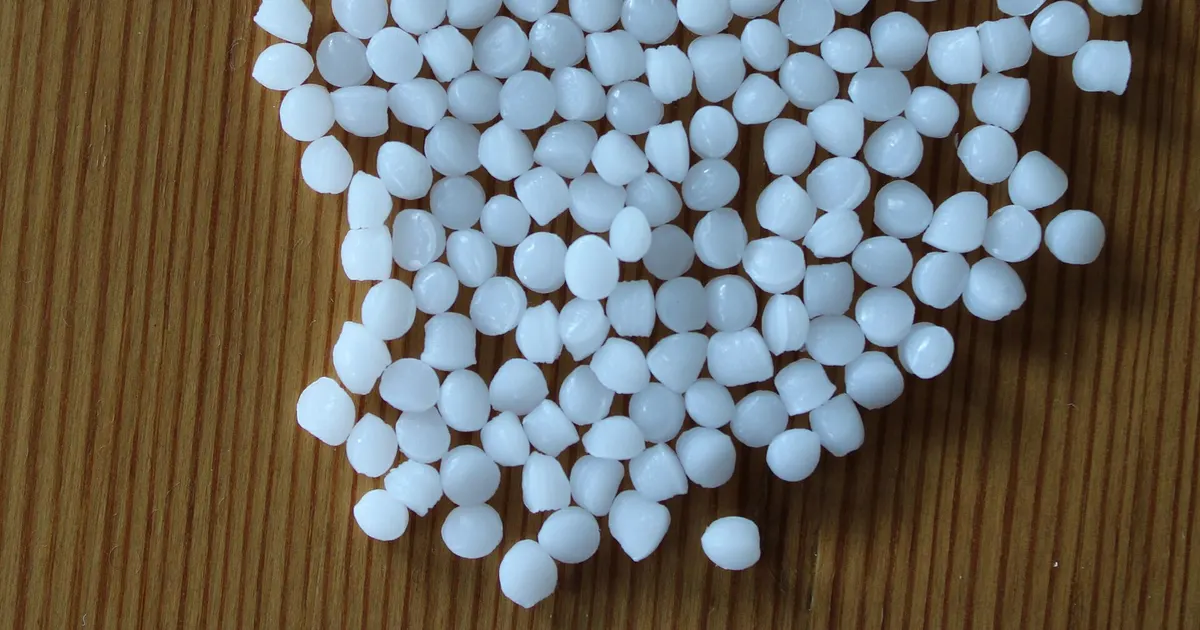
Black and natural acetal come from the same family of resin, and a drawing often just says Delrin without a colour. The choice still matters to the finished part. Colour affects how the part survives sunlight, how easily it is inspected, how marks read and, in some cases, what the supplier can stock.
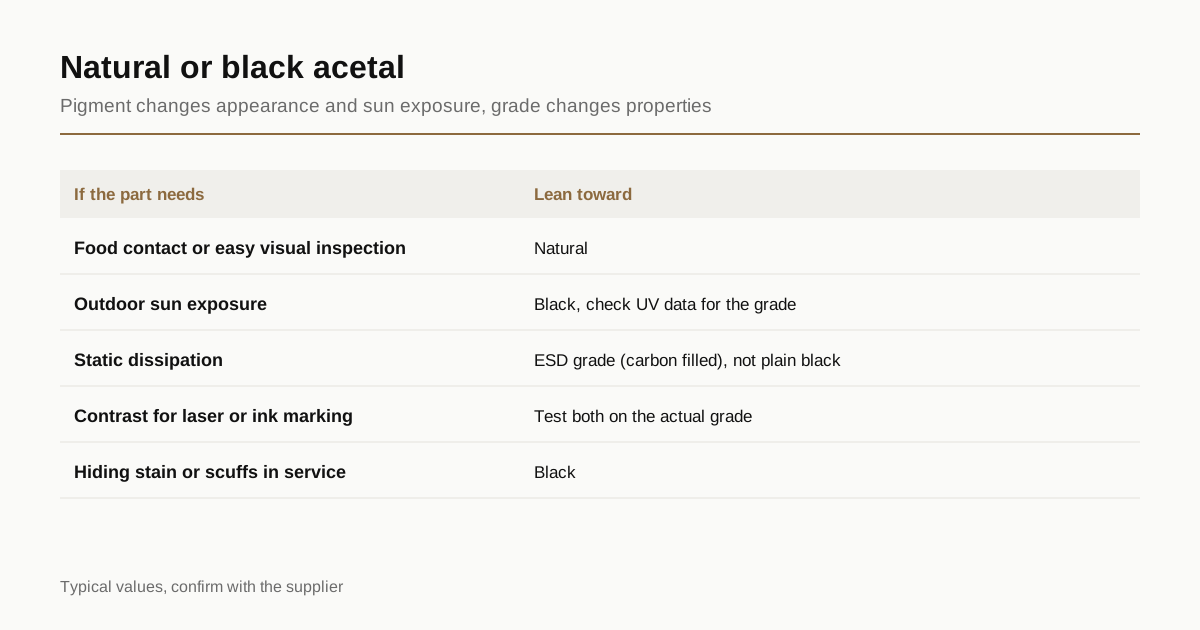
What is actually the same
The base polymer, the process and most mechanical properties are shared:
- Strength, stiffness, hardness and friction are within normal lot variation of each other.
- Machining behaviour is the same, so speeds, feeds and tooling carry across.
- Chemical resistance and water absorption are close.
- Thermal expansion is the same, which matters for measurement and tolerances.
For most mechanical parts that stay indoors, either colour does the same job. The detailed properties are in the material properties guide.
What the pigment changes
| Aspect | Natural | Black |
|---|---|---|
| Appearance | Opaque white to off-white | Uniform black |
| UV and sunlight | Surface chalks and cracks sooner | Better protected |
| Visual inspection | Easy to see chips, voids and contamination | Hides surface faults and voids |
| Optical measurement | Low contrast against pale backgrounds | Good edge contrast |
| Food and medical use | Preferred, subject to grade approvals | Needs a black grade with the right declaration |
| Laser marking | Modest contrast | Often a clear light mark |
| Cosmetic wear | Shows dirt and scuffs | Hides stains |
Sunlight and UV
Unpigmented acetal degrades in sunlight. The surface chalks, loses gloss and eventually cracks. Carbon black is a very effective UV absorber, so black acetal lasts longer outdoors. If the part sits in the sun for years, black or a UV-stabilised grade is the starting point, and the UV-resistant acetal article goes into what to ask for. Black also absorbs heat, so a black part in direct sun runs hotter than a white one, which can matter near the upper temperature limit.
Inspection
Natural acetal shows its own faults. A small void in the centre of a rod, a chip, a trace of contamination or an oil stain stands out on a white surface. On black those defects are harder to see. This helps in cosmetic applications and hurts in quality control. Machined black parts are also harder to read for engraved marks under poor light. If the part is for food or pharma processing, where contamination must be visible, natural or a light colour is the practical choice.
Marking and traceability
Laser marking on black acetal commonly gives a light mark that reads well. On natural acetal the mark is often a modest darkening. Pad printing shows well on black with white ink. See the laser marking guide for the details.
The black grade that is not just a colour
A part described as black acetal could be one of three different things:
| Type | Description | Electrical behaviour |
|---|---|---|
| Black pigmented | Coloured with carbon black or other pigment at low loading | Insulator |
| UV-stabilised black | Pigment plus a stabiliser package for outdoor use | Insulator |
| ESD or conductive | Carbon-filled to dissipate static | Static-dissipative or conductive |
An electronics test fixture or a part near sensitive components needs the third type, and a general black grade will not do. Specify ESD and the surface resistance range on the drawing. For nests and jigs, the fixtures guide goes into this in more detail. Conductive grades often have different mechanical values and machine a little differently from standard grades, so ask the shop.
Cost and availability
Colour changes stock availability more than price. Natural rod and sheet are the most widely stocked, and black is also common in popular sizes. Less common sizes, plates and tube may exist in only one colour. A part that can be made in either colour has a wider choice of stock, so say so on the drawing. Colours such as blue (detectable for food use) and other pigmented grades also exist, as covered in the food grade guide. See also stock sizes and the cost guide.
Price differences between colours of the same grade are usually small compared with size and quantity effects. Ask the shop when it matters, as it varies by distributor and period.
How to choose
| If the part… | Lean toward |
|---|---|
| Touches food or sits in a sanitary line | Natural, or the detectable grade the application requires |
| Lives outdoors in sun | Black, UV-stabilised if long life is needed |
| Must dissipate static | ESD grade, not plain black |
| Is inspected visually for contamination | Natural |
| Is measured on an optical system | Black or a coloured grade |
| Is purely cosmetic and visible | Match the product design |
What to write in the RFQ
State the colour, or state that either is acceptable. If a colour is needed for a reason, such as UV or inspection, say why. A shop that knows the reason can propose a better grade rather than just matching the word on the drawing.
Differences between makers and lots
Colour is not a single standard. Two makers can both sell black acetal with different pigment packages, and the same maker can sell several black grades. Natural acetal also varies in shade, from bright white to a slightly cream tint, depending on the resin and the lot.
This matters in three situations:
- Matching parts across orders. If a part must match an earlier lot in colour, say so and keep a sample. A different maker’s black can look slightly different in sunlight.
- Mixed assemblies. A black part next to a black part from a different material, such as a moulded cover, may look mismatched in strong light.
- Replacement parts. A spare ordered a year later may come from a different stock lot. Record the maker and grade name on the drawing or the order.
For parts with no cosmetic need, avoid fixing a colour at all and allow either. For parts with a functional need, such as UV or static control, write the requirement, not the colour. A line such as static dissipative, surface resistance in a stated range, tells the shop more than the word black. Data sheet properties are also easier to compare when the grade name is given, as in the stock sizes guide.
Checklist before you request a quote
- Write natural, black or either on the drawing.
- Add UV, ESD or food requirements if they apply.
- Give the environment, including sun exposure and temperature.
- Say how the part will be inspected and marked.
- Allow a stock substitution if colour is only cosmetic.
Send the drawing and we match it with up to three shops that machine acetal and reply within 24 business hours.
Frequently asked questions
Is black Delrin stronger than natural?
Not meaningfully. Both use the same base resin, and published strength and stiffness values are close. Small differences come from the pigment and the production lot, so check the datasheet for the specific grade.
Is black acetal the same as ESD acetal?
No. Plain black acetal is coloured with pigment and is still an electrical insulator. ESD or static-dissipative acetal contains conductive carbon and is usually black, so black is not proof of static control.
Which is better for outdoor use?
Black pigmented acetal usually holds up better in sunlight than natural, because the pigment absorbs UV that would otherwise attack the surface. For long outdoor life, ask for a UV-stabilised grade and its weathering data.
Need a quote for this part?
Send the drawing. We match you with up to 3 shops that machine acetal and reply within 24 business hours.
Get matched with a Delrin shop