Guides / Design
Bonding and Joining Delrin: Why Glue Fails and What Works Instead
October 17, 2026
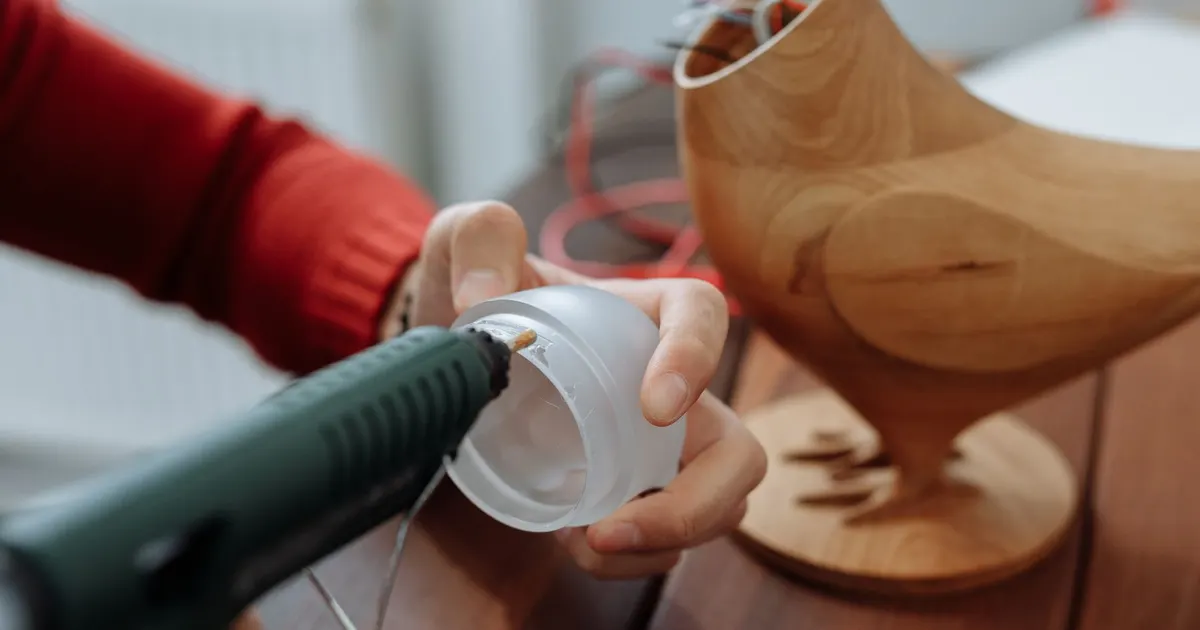
Acetal is one of the hardest engineering plastics to glue. The same properties that make it good for bushings and gears, low friction, chemical resistance and a dense, crystalline surface, work against any adhesive trying to hold on. A joint that looks strong on the bench can peel clean off after a week of vibration or a cycle of heat.
Why adhesives struggle on acetal
Three things get in the way:
- Low surface energy. Adhesives need to wet the surface, and acetal has a surface energy in the high 30s mN/m, not far above polyethylene. A drop of liquid beads up where it should spread.
- Chemical resistance. Acetal does not dissolve in most solvents, so solvent cementing, the trick that works on acrylic, does not work.
- Crystalline, smooth surface. Machined acetal has a tight surface with little for an adhesive to grip mechanically.
Add a high thermal expansion, about 110 micrometres per metre per kelvin, and a bonded joint with metal sees stress at every temperature swing.
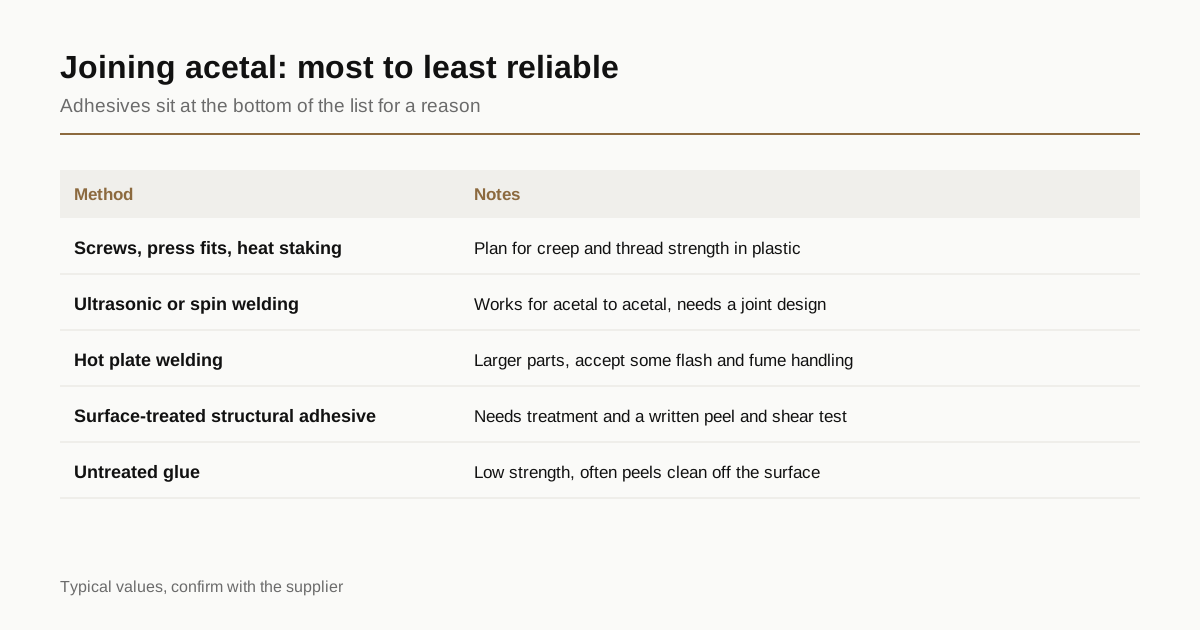
Joining methods, from most to least dependable
Mechanical joints
Screws, press fits, snap fits and retaining rings work with the material rather than against it.
- Screws. Thread-forming screws into acetal bosses are common. For machined parts, a tapped thread works, and a brass or steel insert helps where the joint is opened often. See the threads guide.
- Press fits. Good for bushings and pins. Acetal creeps under constant stress, so design the interference for the long term and allow for thermal movement.
- Snap fits. A good choice for prototypes and light assemblies. The snap fit guide covers the strain limits.
- Retaining rings and clips. Simple and reversible.
Welding
Acetal welds to acetal when the surfaces melt together. Several methods are used:
| Method | How it works | Fits |
|---|---|---|
| Ultrasonic welding | Vibration melts a ridge at the joint | Small and medium parts, designed joint |
| Spin welding | One part rotates against the other | Round parts, caps, plugs |
| Hot plate welding | Faces heated against a plate, then pressed | Larger parts, long seams |
| Hot gas welding | Filler rod melted into a seam | Fabricated tanks and sheets, less precise |
Welds need a joint design: an energy director ridge for ultrasonic welding, a chamfered mating face for spin welding. A machined part can include these features. Welding gives off fumes, and acetal releases formaldehyde when it is overheated, so extraction is needed.
Adhesives
If an adhesive has to be used, give the joint every chance:
- Clean the surface with isopropyl alcohol to remove oils and release agents.
- Treat the surface. Options include flame treatment, plasma or corona treatment and chemical etching. Each raises the surface energy for a limited time, so bond soon after.
- Choose a suitable adhesive. Structural two-part acrylics and some epoxies bond better to treated acetal than general-purpose glues. Some cyanoacrylates with a primer made for low-energy plastics are used for small parts.
- Design the joint for shear and large area. Adhesives do best in shear over a wide overlap and worst in peel.
- Test. Lap-shear and peel tests on samples made from the actual grade and surface finish are the only proof.
Typical lap shear strength on untreated acetal is low, and results vary widely between adhesives. Treat any figure from a datasheet for a different plastic as unproven until tested on acetal.
Designing for the joint you can rely on
Rather than fighting the material, change the design:
- Replace a bonded joint with a fastened one. A screw boss costs less than a failed assembly.
- Make one part from one piece. A single machined acetal part can replace a bonded two-part assembly.
- Capture the part mechanically. A groove and a retaining ring or a lip that locks the part in place carries the load, with adhesive as a seal at most.
- Use a different material for the bonded face. Another plastic that bonds more easily can replace acetal at the joint face, if the function allows.
If one part has to bond to another material, such as a steel shaft, an interference fit or a knurled press fit usually outlasts an adhesive. For bushings and bearings, see the bushing design guide.
Gaskets, seals and sealants
Sealing is different from structural bonding. A sealant that does not need to carry load can hold on acetal long enough to seal, but it should still be checked for adhesion and chemical compatibility. O-ring grooves and gasket faces are usually a better route than a bonded seal. Check the chemicals the part sees using the chemical resistance guide.
What to tell the shop
If the design includes a joint, say so in the RFQ:
| Item | Why it matters |
|---|---|
| Joining method intended | The shop can add welding ridges or screw bosses |
| Mating material | Affects interference and expansion |
| Load and environment | Decides if an adhesive is acceptable at all |
| Surface finish on joint faces | Affects adhesion and weld quality |
| Quantity | Welding tools make sense for runs, not single parts |
Many shops that machine acetal do not weld or treat surfaces in house. If the assembly needs it, ask who handles it.
Testing a joint before you commit
If an adhesive joint is unavoidable, test it on samples made from the same stock, finish and surface treatment as the real part. A basic test plan has three steps:
- Lap shear samples. Bond two strips with a known overlap, cure as specified and pull to failure. Record the load and note whether the failure was in the adhesive, at the interface or in the plastic.
- Peel or impact check. Joints in service rarely see only shear. A simple peel test shows weakness at the edge of the bond.
- Environmental cycling. Soak samples in the expected fluids, cycle them through the temperature range and repeat the pull. Acetal expands about 110 micrometres per metre per kelvin, so cycling shows stress that a room temperature test hides.
A clean interface failure means the adhesive never bonded to the acetal, and a better surface treatment or a different adhesive is needed. A failure inside the adhesive is a better sign. Keep records of the surface treatment, the time between treatment and bonding and the cure schedule, because small changes in any of them move the result.
Checklist before you request a quote
- Decide whether the joint can be mechanical.
- If welding, include a joint design on the drawing.
- If bonding, specify the surface treatment and the adhesive family, and plan a test.
- Allow for thermal expansion between acetal and the mating part.
- State the load, the temperature range and the chemicals the joint sees.
Send the drawing with the assembly notes and we match it with up to three shops that machine acetal and reply within 24 business hours.
Frequently asked questions
Can you glue Delrin?
Only with difficulty. Standard adhesives bond poorly to acetal because the surface is smooth, low in energy and chemically resistant. Surface treatment plus a suitable adhesive can reach a usable joint, but it needs testing on the actual grade.
What is the best way to join acetal parts?
Mechanical joining such as screws, press fits and snap fits is the most dependable. Ultrasonic and spin welding work well for acetal to acetal joints when the part is designed for them. Adhesives are a last resort.
Does roughening the surface help adhesives stick?
It helps a little by increasing the contact area, but it does not change the surface chemistry. Roughening alone rarely gives a reliable joint. Chemical, flame or plasma treatment changes the surface, and even then the joint should be tested.
Need a quote for this part?
Send the drawing. We match you with up to 3 shops that machine acetal and reply within 24 business hours.
Get matched with a Delrin shop