Guides / Design
Acetal Snap Fits and Clips: Design Rules for Machined Prototypes
October 11, 2026
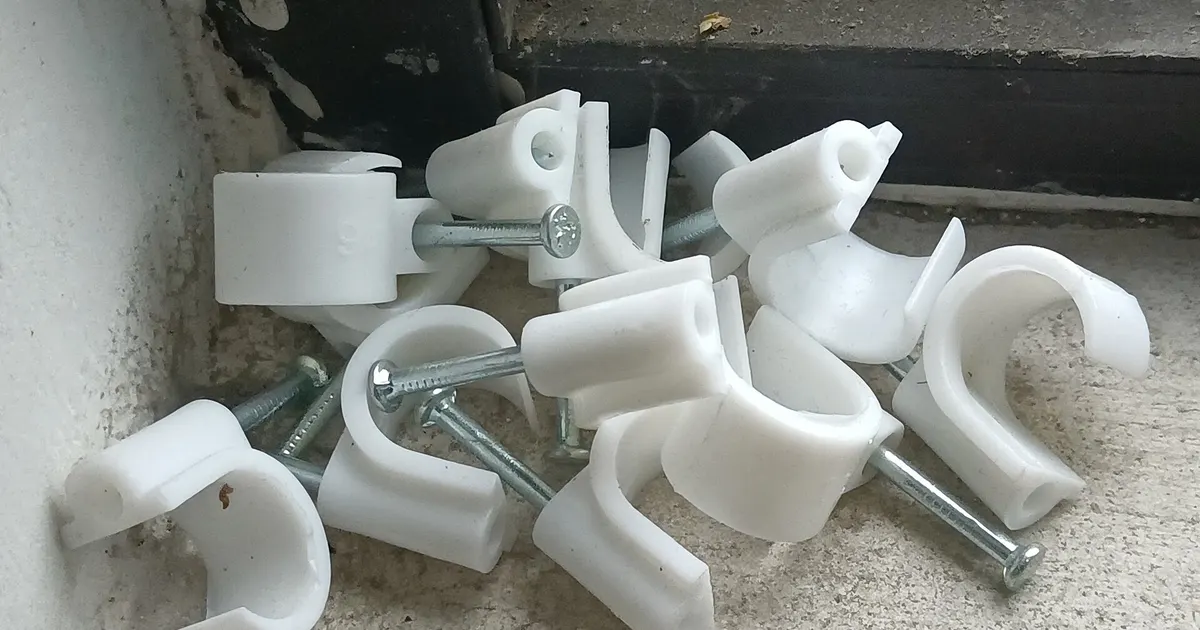
A snap fit is a feature that bends during assembly and springs back to lock. It replaces a screw, a clip or a bit of adhesive, and it costs nothing per part once the tool is paid for. Acetal is one of the best materials for snap fits because it is stiff, springy and slippery. When a snap fit is machined from stock for a prototype or short run, the design rules still apply, and a few extra details matter.
The basic cantilever snap fit
The most common form is a beam fixed at one end with a hook at the free end. When the hook rides over a ledge, the beam bends. After the hook clears, the beam springs back and the ledge holds the mating part.
Four numbers describe it:
- Length (L) of the beam, from the root to the hook.
- Thickness (t) of the beam at the root.
- Deflection (y) needed for the hook to clear the ledge.
- Strain (e), the stretch at the outer surface of the beam at the root.
The strain formula
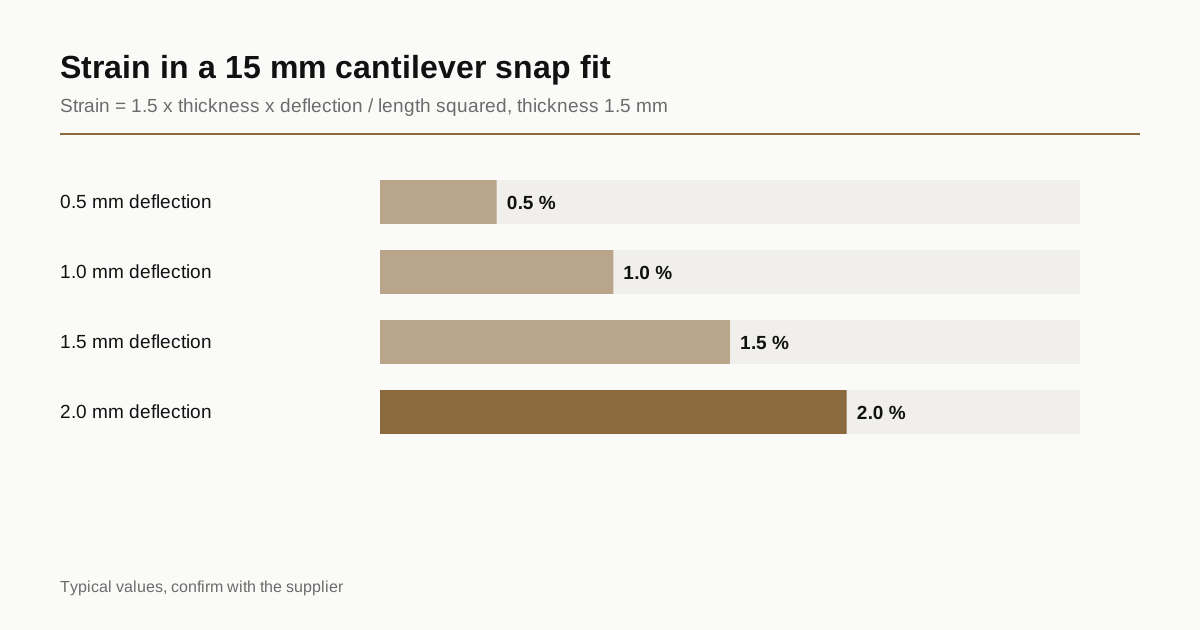
For a straight beam of constant rectangular section, the maximum strain at the root is:
strain = 1.5 x t x y / L squared
With t, y and L in the same units, the result is a fraction. Multiply by 100 for percent. A worked example:
| Beam length | Thickness | Deflection | Strain |
|---|---|---|---|
| 15 mm | 1.5 mm | 0.5 mm | 0.5 percent |
| 15 mm | 1.5 mm | 1.0 mm | 1.0 percent |
| 15 mm | 1.5 mm | 2.0 mm | 2.0 percent |
| 10 mm | 1.5 mm | 1.0 mm | 2.25 percent |
| 20 mm | 1.5 mm | 1.0 mm | 0.56 percent |
The length is squared, so a longer beam cuts strain quickly. Doubling the thickness doubles the strain at the same deflection. The simple answer to a high strain is a longer or thinner beam, or less deflection.
What strain is safe
Acetal has a yield strain well above the few percent used in snap fit design, but repeated bending at high strain causes fatigue and creep, and the beam can take a set. The limit depends on the grade, the number of assembly cycles and the temperature. A common practice is:
- Single assembly, or rare disassembly: a few percent can be acceptable.
- Repeated assembly, many cycles: keep strain well below that, and test.
- Higher temperature: lower the limit, because creep rises.
Do not take one number from a general guide. Look up the allowable strain in the grade’s datasheet or the maker’s snap-fit guide, and apply a safety margin. See the material properties guide for context.
Design details that prevent cracking
| Detail | Rule of thumb |
|---|---|
| Root radius | Use a fillet at the base of the beam, about half the beam thickness or more, because a sharp corner concentrates stress |
| Beam shape | A tapered beam, thicker at the root and thinner at the tip, spreads the strain and lowers the peak |
| Lead-in angle | A shallow ramp on the hook eases assembly, a steep return face holds the part |
| Return angle | A square return locks permanently, an angled return allows release |
| Wall behind the root | Avoid thin walls behind a beam, which flex and share the strain badly |
| Surface at the root | Fine finish, no tool marks across the beam |
A root fillet is the single best protection against a snap-fit crack. Machine it with a ball or radiused end mill, and avoid a small cutter that leaves a series of scallops. Tool marks across the root work as notches. The surface finish guide explains the cutting data that gives a clean fillet. Additional rules for radii and wall thickness are in the design guide.
Machined prototype versus moulded part
A machined snap fit is a good way to test geometry before paying for a mould, but it is not the same part:
| Aspect | Machined from stock | Injection moulded |
|---|---|---|
| Structure | Uniform, from extruded stock | Skin and core, orientation from flow |
| Surface | Tool marks unless finished | Mould surface, smooth |
| Residual stress | From extrusion and machining | From moulding and cooling |
| Weld lines and gates | None | Possible weak points |
| Shrinkage | Stock size is stable | Part shrinks after moulding |
| Cost per part | High for small runs | Low in volume |
A machined beam may be stronger or weaker than the moulded one, so a pass in machined parts does not guarantee a pass in production. Use the prototype to prove fit, feel and assembly force, and expect a second round of testing on the moulded part. The comparison in the machining versus injection moulding guide explains where each route fits.
Assembly force and feel
The force to push the hook past the ledge depends on beam stiffness and friction. A longer beam and a shallower lead-in lower the force. If the clip feels too stiff or too loose in a prototype, lengthen or thicken the beam, or alter the ramp angle. Acetal’s low friction helps the hook slide over the ledge, but it can also let a loaded hook slip out if the return face is too shallow.
Creep and storage
A snap fit that stays deflected for a long time, for instance a clip stored in the open position or a part that is assembled and left under load, relaxes. The beam takes a set, and the holding force drops. Design so the beam rests unstrained once assembled, and the hook then sits in the ledge with a small residual force only. Heat accelerates creep. For temperature limits, see the chemical and temperature guide.
Tolerances
A snap fit depends on the overlap between the hook and the ledge, usually a few tenths of a millimetre to a millimetre or so. Temperature and moisture shift both parts, and the acetal expands about 110 micrometres per metre per kelvin. Allow for that in the overlap, and state the tolerance on the hook and ledge dimensions in the drawing. See the tolerances guide and the inspection guide.
Other forms of snap fit
- Annular snap fits snap a ring over a bead, as in a cap or a bushing. They use hoop strain instead of bending.
- Torsional snap fits twist a bar and spring back.
- Living hinges and flexures bend repeatedly. In machined parts, a thin web hinge works for prototypes, but life depends on thickness and radius. Acetal is less used for long-life living hinges than polypropylene.
Checklist before you request a quote
- State the beam dimensions, deflection and the strain you calculated.
- Specify the root fillet radius and the finish at the root.
- Say how many assembly cycles are expected.
- Give the grade, or ask for acetal copolymer or homopolymer to be compared.
- State the intent: fit prototype or functional test, and quantity.
- Attach the mating part’s drawing so the shop sees the ledge.
Send the drawing and we match it with up to three shops that machine acetal and reply within 24 business hours.
Frequently asked questions
Is acetal good for snap fits?
Yes. Acetal is stiff, springy and fatigue resistant, and it has low friction so the latch slides into place. It is a common material for clips, latches and living-hinge style features.
How much strain can an acetal snap fit take?
For repeated assembly, designers commonly stay at a few percent strain, well below the yield strain in the datasheet. Single assembly can go higher. Always check the figure for the specific grade, and test the real part.
Will a machined prototype behave like the moulded part?
Not exactly. Machined parts come from extruded stock with a different structure from a moulded skin, and tool marks can start cracks. A machined prototype shows the geometry and the fit, but the moulded part needs its own testing.
Need a quote for this part?
Send the drawing. We match you with up to 3 shops that machine acetal and reply within 24 business hours.
Get matched with a Delrin shop