Guides / Process
Cutting Delrin Sheet to Blanks: Waterjet, Router or Saw
October 18, 2026
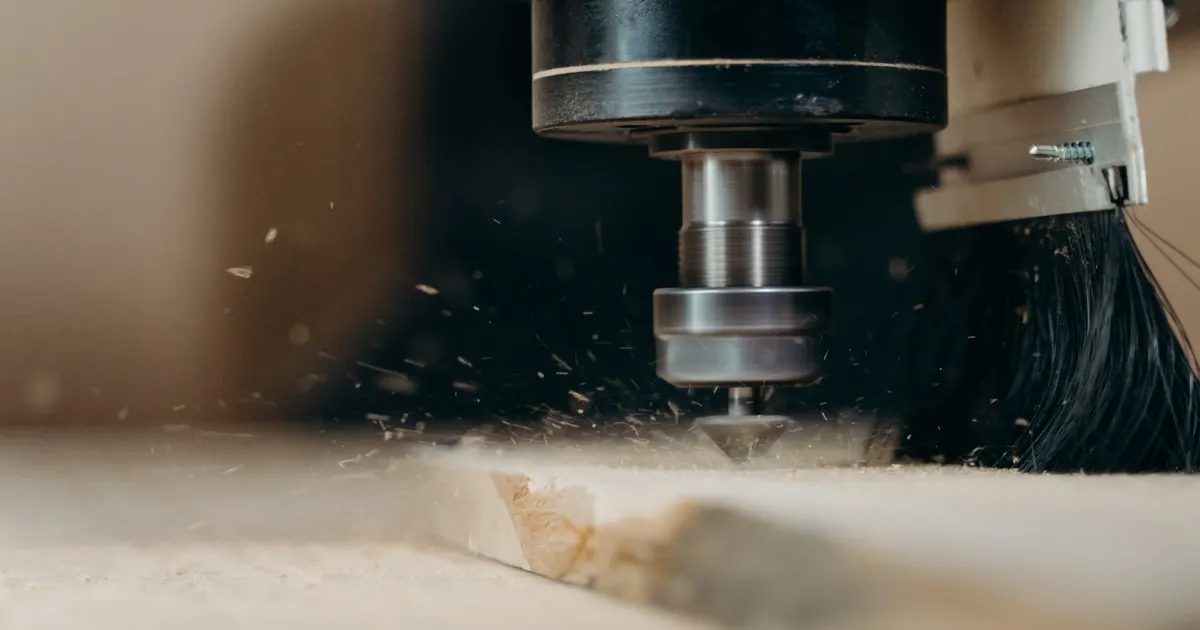
Many acetal parts start as a flat plate cut into smaller blanks, then machined to final size. How the blank is cut sets the cost of the next steps. A clean, close blank saves roughing time. A rough one adds machining and wastes sheet. The three common methods are abrasive waterjet, CNC router and panel saw, and each suits a different situation.
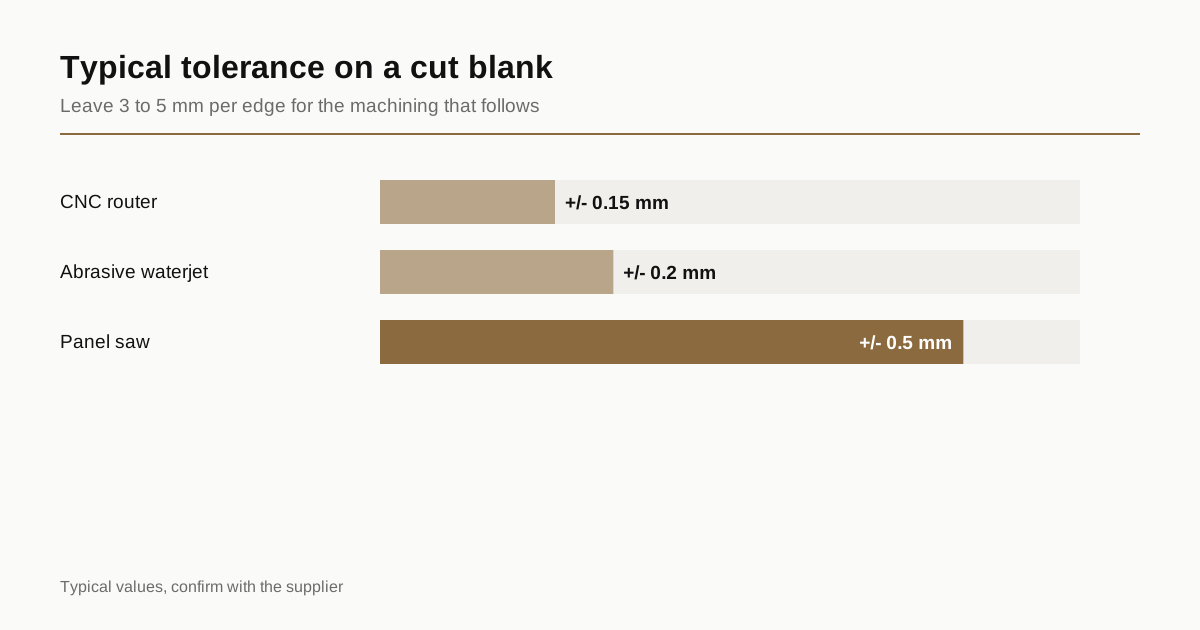
The three main methods
| Method | Typical tolerance | Edge quality | Best for |
|---|---|---|---|
| Abrasive waterjet | plus or minus 0.1 to 0.25 mm | Satin finish, slight taper | Complex outlines, thick sheet, nesting |
| CNC router | plus or minus 0.1 to 0.2 mm | Smooth, milled edge | Profiles, pockets and holes in one setup |
| Panel or table saw | plus or minus 0.5 mm | Fine saw marks | Straight cuts, quick rectangular blanks |
These are typical figures and every shop’s machine, thickness and setup shifts them. For tighter results, a finish pass on a mill follows the rough cut.
Abrasive waterjet
A high-pressure stream of water carrying garnet abrasive cuts through almost any plastic. There is no heat, so acetal does not melt or release fumes, and cutting is possible on thick sheet.
Advantages
- No heat-affected zone.
- Complex outlines and tight nesting, so less sheet is wasted.
- Thick sheet is handled, up to 100 mm or more.
Cautions
- Taper. The jet widens as it travels, leaving a slightly angled edge. Slower cutting reduces it.
- Pierce cracking. Piercing thick plastic can crack it around the start point. Shops use low-pressure piercing or start from an edge or a pre-drilled hole.
- Garnet embedding. Abrasive can embed in the surface at the pierce and the edge. Wash and inspect.
- Water and drying. Acetal absorbs little water, but sheets are dried before precision machining.
- Rough lower band. The lower part of the edge shows striations. Leave allowance to machine them off.
CNC router
A CNC router cuts with a rotating cutter, much like a mill, and gives a smooth edge that is often good enough as a final surface.
Advantages
- Edges come out clean, with no taper.
- Holes, pockets and profiles in one setup.
- Fast on thin and medium sheet.
Cautions
- Holding. Sheet is held on a vacuum table or by clamps. A bowed sheet can lift or chatter, so the setup matters. See the flatness guide for how to hold plate.
- Cutter choice. Single-flute upcut or O-flute cutters made for plastics clear chips and avoid melting. A dull cutter melts the edge and leaves a string of swarf that welds onto the sheet.
- Feed and heat. Too slow a feed heats the edge. Too fast a feed chips it.
- Corner radius. The cutter diameter sets the smallest inside radius.
For cutting guidance, the speeds, feeds and tooling guide applies to routers as well.
Panel saw and table saw
A carbide-tipped blade cuts straight lines quickly and cheaply. For rectangular blanks and strips it is often the fastest method.
Advantages
- Lowest cost per cut and no setup programming.
- Good for long, straight strips from a large sheet.
Cautions
- Blade type. A triple-chip or alternate-top-bevel carbide blade with little hook cuts plastics cleanly. A wood blade can chip and grab.
- Feed rate. A steady, firm feed avoids melting. Dwelling in the cut heats the edge.
- Tolerance. Straight and square to about 0.5 mm, so the blank needs more allowance.
- Support. Thin sheet needs support near the blade to avoid vibration.
Which method suits which job
| Job | Suggested method |
|---|---|
| Rectangular blanks, simple strips | Panel saw |
| Many identical outlines, thin to medium sheet | CNC router |
| Complex or curved outlines in thick sheet | Waterjet |
| Blanks nested tightly to save material | Waterjet |
| Blank plus holes and pockets in one pass | CNC router |
| Large plates for stress-sensitive parts | Saw or router, then rest the blanks |
For small runs the right answer is often the machine the shop already has running that day. A shop that cuts well on its saw will usually give a better result than one forcing a job onto a machine it uses rarely.
Allowance for the machining that follows
The blank has to be big enough to clean up. Allow:
- 3 to 5 mm per edge beyond the finished outline for waterjet or router.
- 5 mm or more per edge from a saw cut that is square to 0.5 mm.
- Extra on thickness if the sheet is not flat. A bowed sheet needs enough stock to machine flat on both faces. Extruded sheet is often supplied with a small thickness tolerance, and the stock sizes guide lists typical ranges.
A blank cut too close leaves no room for stress relief movement, and the part ends up undersize or out of flat. Blanks cut from thick sheet can be set aside to rest before final machining. See the annealing guide for when that matters.
Material yield and cost
Cutting is a small part of the part price, but sheet is a large part. Nesting blanks well saves more than a slightly cheaper cut. Ask the shop how the blanks are nested and whether offcuts can be used for other parts in the same order. The cost guide shows how material and machining split in a typical quote.
Handling and storing blanks
Cut blanks are not finished parts, and what happens to them before machining can undo careful cutting. A few habits help:
- Keep the protective film on until the part is fixtured, since sheet scratches easily.
- Stack flat and support evenly. A stack of blanks on an uneven shelf can take a set, which shows up as bow later.
- Avoid heat sources and direct sun. Acetal expands with temperature, and blanks stored in a warm spot measure differently from blanks stored cool.
- Let thick blanks rest. Cutting releases stress along the edges, and a blank cut from thick sheet often moves a little. Rest it for several hours or overnight before finish machining.
- Mark the grade and lot on the stack, so stock traceability survives cutting.
Offcuts are worth keeping. They make useful test pieces for settings, marking trials and fixtures, and they can be used for smaller parts in the same order. A shop that tracks offcuts by lot can often reuse them without mixing grades.
Checklist before you request a quote
- State the sheet thickness and the finished outline.
- Say if edges must be machined or can stay as cut.
- Allow for a blank size that cleans up, 3 to 5 mm per edge.
- Ask which cutting method the shop will use, and why.
- Note if the part is stress-sensitive so blanks can be rested.
- Give the quantity to decide between nesting and individual blanks.
Send the drawing and we match it with up to three shops that machine acetal and reply within 24 business hours.
Frequently asked questions
Can you waterjet cut Delrin?
Yes. Abrasive waterjet cuts acetal without heat, so there is no melting or fume. Care is needed on thick sheet at the pierce point, where the jet can crack the material, and the edge shows a slight taper and a rougher lower band.
Can acetal be laser cut?
It is generally avoided. A laser melts the edge and releases formaldehyde, and the edge comes out rough and discoloured. Waterjet, router or saw cutting is the usual choice.
How much stock should a blank have for machining?
Typically 3 to 5 mm per edge beyond the finished outline, depending on the cut method and thickness. A blank cut closer than that can leave no material to clean up the taper and the cut edge.
Need a quote for this part?
Send the drawing. We match you with up to 3 shops that machine acetal and reply within 24 business hours.
Get matched with a Delrin shop