Guides / Materials
Acetal vs PET and PBT: Choosing for Precision Mechanical Parts
October 13, 2026
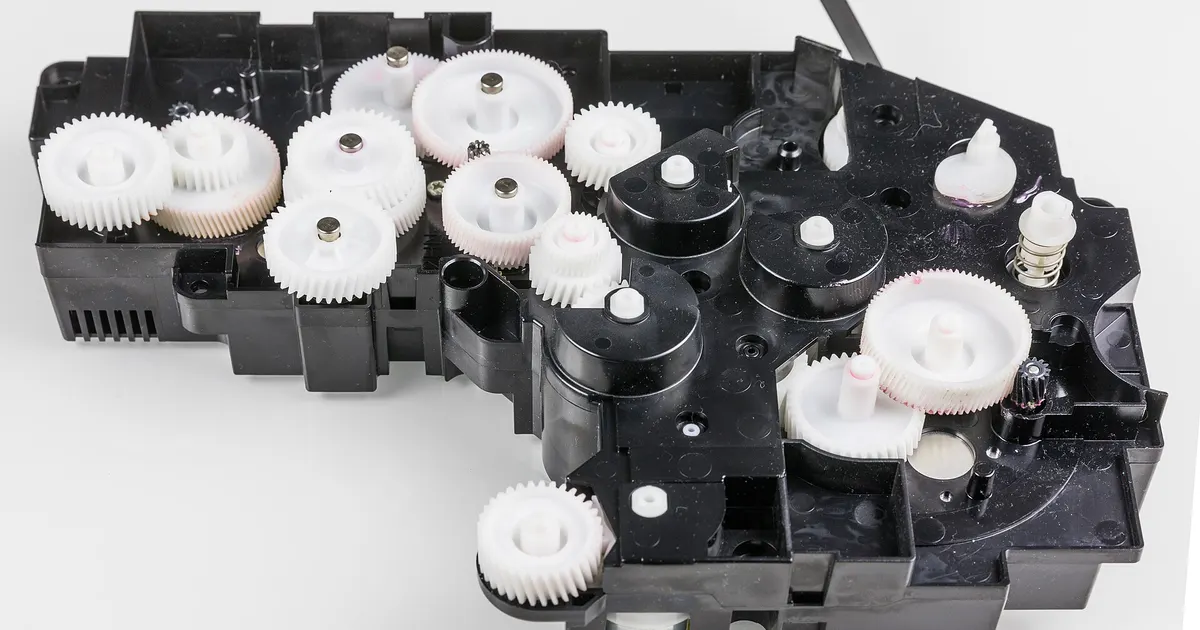
Acetal is the default choice for many precision plastic parts, and when a buyer asks about an alternative, PET and PBT are the usual candidates. They sit in a similar range of stiffness and strength, but they behave differently with heat, water and sliding contact. Knowing where each gains and loses avoids picking the wrong one for a part that has to hold tight dimensions.
What PET and PBT are
PET (polyethylene terephthalate) and PBT (polybutylene terephthalate) are both semi-crystalline polyesters. In machined form, PET stock sold as a bearing and wear grade is common, and PBT stock is less common and often supplied for specialist uses. Both are also widely used in injection moulded parts, so material data you find online may describe the moulded grade, not the machined stock.
Acetal is also semi-crystalline and is often chosen for sliding, snap and gear parts. For comparison with other plastics, see the guides on acetal versus nylon and acetal versus PEEK.
Typical values side by side
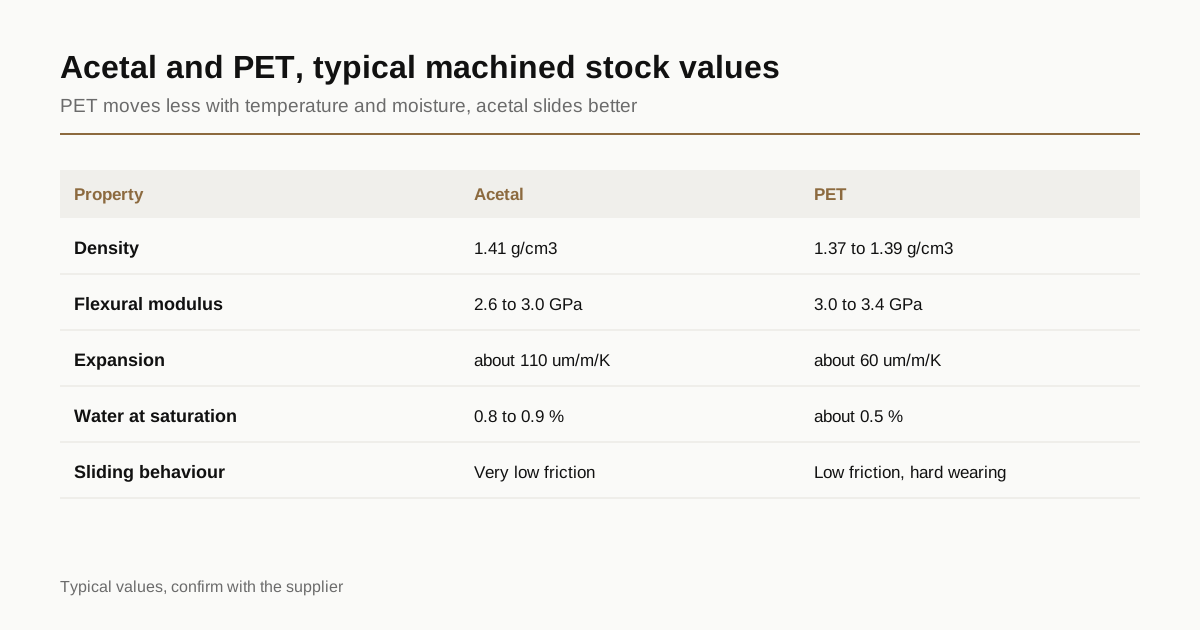
| Property | Acetal | PET (machined stock) | PBT |
|---|---|---|---|
| Density | 1.41 g/cm3 | 1.37 to 1.39 g/cm3 | 1.30 to 1.31 g/cm3 |
| Flexural modulus | 2.6 to 3.0 GPa | 3.0 to 3.4 GPa | 2.3 to 2.6 GPa |
| Linear expansion | about 110 um/m/K | about 60 um/m/K | about 100 um/m/K |
| Water at saturation | 0.8 to 0.9 % | about 0.5 % | about 0.5 % |
| Continuous use temperature | 90 to 100 C | about 100 C | about 100 to 120 C |
| Sliding friction | Very low | Low | Low |
These ranges differ by maker and test method, so use them as a guide only and read the datasheet for the grade you are buying.
Dimensional stability
PET moves less than acetal in two ways. Its thermal expansion is roughly half, and it absorbs less water. For a part with tight tolerance over a wide temperature range, or one that sits in a humid environment, that makes PET attractive.
A concrete example: a 100 mm feature changes by about 0.011 mm per degree in acetal and about 0.006 mm per degree in PET. Over a 30 degree swing that is 0.33 mm for acetal and 0.18 mm for PET. See the water absorption guide and the inspection guide for how both effects reach a measurement.
Friction and wear
Acetal is hard to beat for dry sliding at moderate load and speed. Its friction is low and steady, and it runs quietly. PET stock sold for bearings has good wear resistance and is harder, so it handles abrasive environments and heavier loads better in some cases, but its friction tends to be higher and it can be less forgiving on a rough counterface.
For gears, bushings and slides:
- Acetal is the first choice for low-noise, low-friction gear and bushing parts. See the gear design guide.
- PET works for wear plates, guide rails and gears that need dimensional stability and a hard surface, particularly in wet conditions.
- PBT in machined form is less common, with uses where its electrical or chemical properties help.
Chemical and temperature behaviour
| Condition | Acetal | PET and PBT |
|---|---|---|
| Hot water and steam | Limited, the homopolymer is weaker than the copolymer | Hydrolyses over time in hot water, check grade |
| Strong acids | Attacked | Attacked by strong bases and some acids |
| Strong bases | Good, copolymer is better | Attacked by strong bases |
| Solvents and fuels | Good | Good |
| Chlorinated water | Can degrade | Better in many cases |
Both families have weak spots. Polyesters hydrolyse in prolonged hot water, so neither suits steam. Acetal is attacked by chlorine and strong acids. For detailed information, see the chemical and temperature guide.
Machining
Acetal machines cleanly, produces a good surface and holds tolerance. PET is harder and a little more abrasive on tooling. It cuts well with sharp carbide, though chips are typically tougher and heat builds if the tool is dull. PBT machines similarly to PET, and the stock, when available, can show more residual stress. For cutting data on acetal, see the speeds, feeds and tooling guide.
Residual stress and moisture matter for all three. PET parts can be annealed to stabilise them, much like acetal.
Cost and availability
Acetal is stocked widely and in many sizes. PET stock is common in rod and plate, though less so than acetal. PBT stock is the hardest to find. Prices vary with market and size, and PET stock often costs a little more than acetal for the same size. If a part is a candidate for either, ask the shop for a quote on both. The cost guide shows how material and machining split.
Choosing between them
| Priority | Lean toward |
|---|---|
| Lowest friction and quiet running | Acetal |
| Tightest size stability with heat and moisture | PET |
| Wear against abrasive material | PET |
| Widest stock choice and lowest cost | Acetal |
| Electrical insulation with chemical resistance | PBT or PET |
| Chlorinated water exposure | PET or PBT, after checking data |
| Snap fits and living hinges | Acetal |
Worked example: a bushing over a temperature range
Consider a flanged bushing with a 20 mm bore running on a steel shaft between 10 C and 50 C. The bore changes size by the plastic’s expansion coefficient times the diameter times the temperature change from the reference.
| Material | Expansion | Bore change from 20 C to 50 C | Bore change from 20 C to 10 C |
|---|---|---|---|
| Acetal | about 110 um/m/K | about +0.066 mm | about -0.022 mm |
| PET | about 60 um/m/K | about +0.036 mm | about -0.012 mm |
| Steel shaft | about 12 um/m/K | about +0.007 mm | about -0.002 mm |
The running clearance at 20 C has to cover the largest change in either direction. With acetal, a cold bore shrinks onto the shaft while a hot bore opens up, and the clearance window is about 0.09 mm wide before the machining tolerance is added. With PET the window is about half that. If the application cannot tolerate a clearance swing of that size, PET or a different design is the better answer. If a bit of play is fine, acetal’s friction advantage wins.
The same arithmetic works for any feature: multiply the length by the expansion and by the temperature swing. The bushing and bearing guide shows how to set clearance from these numbers.
Checklist before you request a quote
- State the temperature range and humidity the part sees.
- Give the tolerance and the length it applies to.
- Describe any sliding contact: load, speed and counterface.
- Say if the part sees hot water, chlorine or strong chemicals.
- Allow the shop to propose PET or acetal and quote both.
Send the drawing and we match it with up to three shops that machine acetal and reply within 24 business hours.
Frequently asked questions
Is PET stronger than acetal?
Machined PET stock is a little stiffer and harder than acetal and holds its size better, while acetal is slightly tougher in impact and has lower friction in many sliding pairs. The two are close enough that the deciding factors are usually moisture, temperature and friction, not raw strength.
Can PBT be machined from stock?
It can, though machined PBT stock is stocked less widely than acetal or PET. Many PBT parts are injection moulded, so check the availability of rod or plate in the size you need before choosing it for a machined part.
Which is better for gears, acetal or PET?
Acetal is the long-standing choice for gears because of its low friction, fatigue strength and easy machining. PET suits gears that need tighter stability in wet or warm conditions and has good wear resistance, though friction is usually a little higher.
Need a quote for this part?
Send the drawing. We match you with up to 3 shops that machine acetal and reply within 24 business hours.
Get matched with a Delrin shop