Guides / Materials
Acetal vs PTFE: Seals, Valve Seats and Low-Friction Parts Compared
October 14, 2026
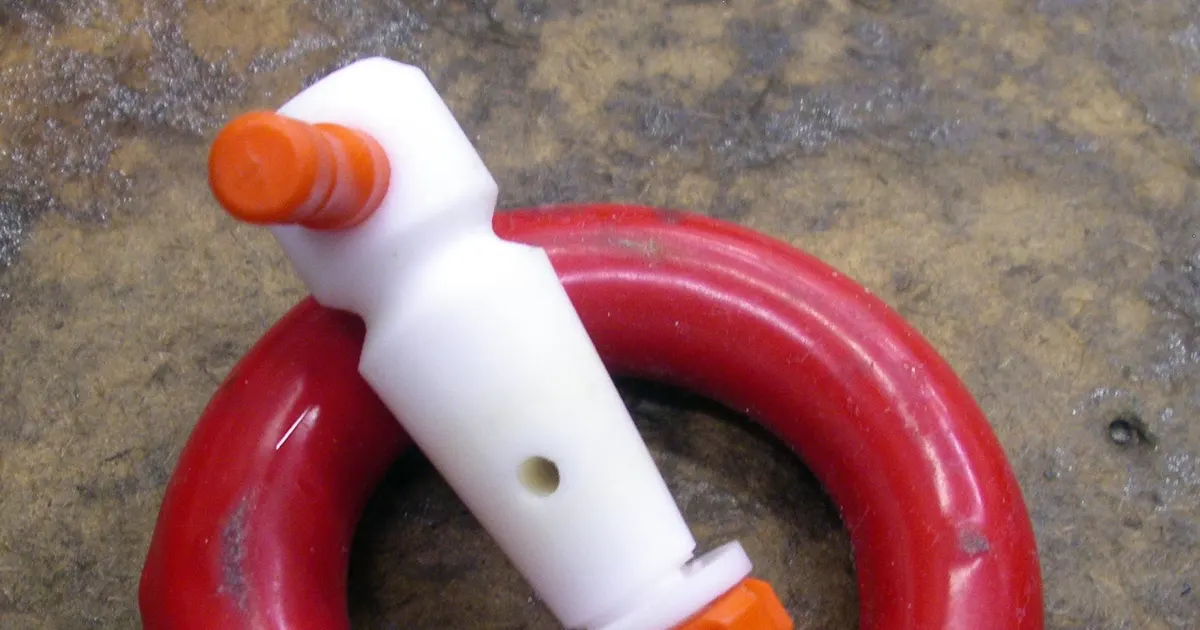
PTFE and acetal are the two plastics most often considered for sliding, sealing and low-friction parts. They look similar on a shelf, both white and waxy, but they are different materials with almost opposite strengths. PTFE is nearly inert and slides on almost anything. Acetal is stiff, strong and holds shape. Choosing the right one depends on which of those properties the part needs most.
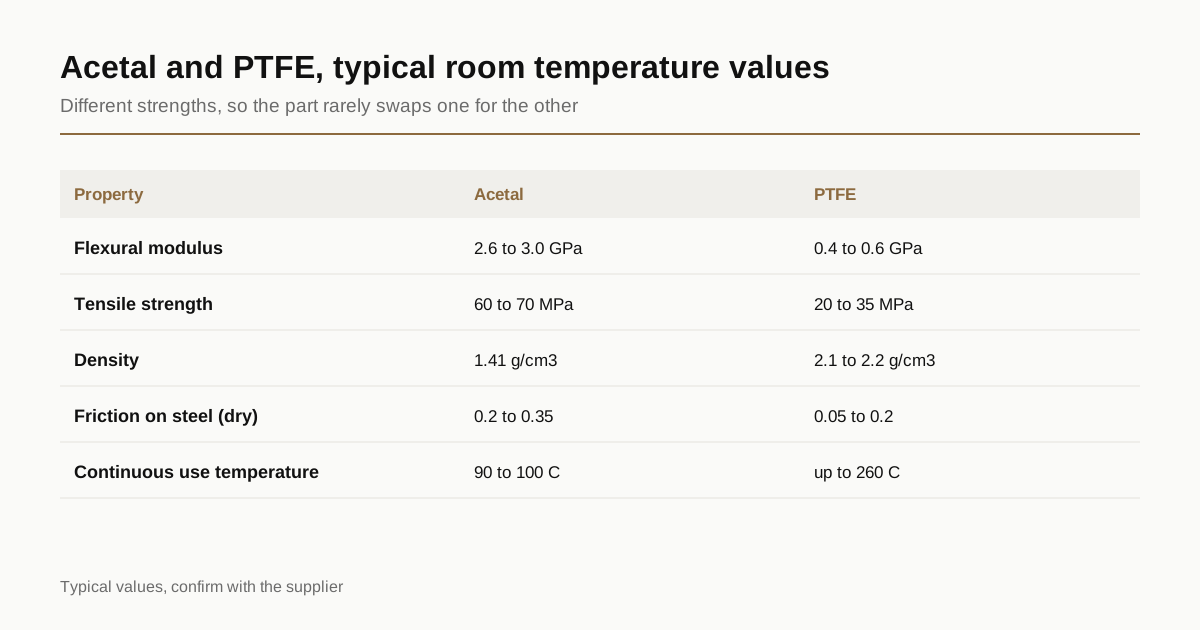
Typical properties side by side
| Property | Acetal | PTFE |
|---|---|---|
| Flexural modulus | 2.6 to 3.0 GPa | 0.4 to 0.6 GPa |
| Tensile strength | 60 to 70 MPa | 20 to 35 MPa |
| Density | 1.41 g/cm3 | 2.1 to 2.2 g/cm3 |
| Dry friction on steel | 0.2 to 0.35 | 0.05 to 0.2 |
| Continuous use temperature | 90 to 100 C | up to about 260 C |
| Chemical resistance | Good, weak to strong acids and oxidisers | Excellent, nearly inert |
| Creep under load | Low to moderate | High (cold flow) |
| Machining | Cuts cleanly, holds tolerance | Soft, springs back, harder to hold tolerance |
Values vary by grade and test method, so treat them as a guide and use the datasheet of the actual material. The material properties guide lists typical acetal values in more detail.
Where PTFE wins
Chemical and temperature resistance. PTFE resists almost every acid, base and solvent and survives temperatures that would soften or degrade acetal. For aggressive chemicals, chlorinated water or high-temperature fluids, it is often the only plastic that works. The chemical resistance guide shows where acetal stops.
Lowest friction. For light-load sliding without lubricant, PTFE has a very low coefficient of friction, and it has little stick-slip. It suits dry bearings at low load, slide plates and non-stick faces.
Sealing. PTFE conforms to a mating surface and seals on a soft face. Lip seals, gaskets and envelope seals use that behaviour.
Where acetal wins
Stiffness and strength. Acetal is five times stiffer than PTFE and several times stronger. A gear, a cam, a roller, a bearing sleeve under load or a structural spacer needs those properties. PTFE would deform.
Creep. PTFE flows slowly under constant load, so a PTFE part that is clamped or preloaded loosens over time. Acetal creeps much less, so a fastened joint or a valve stem seat holds.
Machining tolerance. Acetal cuts cleanly and stays at size, so tight bores and fine features are practical. PTFE is soft and elastic, springs back after cutting and expands with temperature, making close tolerances hard. See the tolerances guide.
Cost and availability. Acetal stock is cheaper per kilogram and per part, and it is stocked in more sizes. PTFE costs more and is denser, so a PTFE part of the same volume weighs and costs more.
Wear against hard counterfaces. Pure PTFE wears quickly under load. Acetal wears better in most loaded sliding pairs. See the bushing design guide.
Seals and valve seats
Valve seats sit between two jobs. They have to seal, which suits a soft material, and they have to resist the pressure of the closed valve, which suits a stiff one.
| Condition | Better choice |
|---|---|
| Water, air or mild chemicals, moderate temperature | Acetal seat, stiffer and holds its sealing face |
| Aggressive chemicals or high temperature | PTFE or related fluoropolymer |
| High pressure with a soft seat | PTFE with a backing ring or a filled grade |
| Frequent cycling | Acetal for wear, PTFE-filled acetal if friction is a problem |
| Drinking water | Check approvals and chlorine resistance for the exact grade |
For drinking water, the grade needs approvals, and chlorinated water can attack acetal. The valve components guide goes into what to check. PTFE is generally better against chlorine.
PTFE-filled acetal as a middle path
Some parts need acetal stiffness and a lower friction surface. Acetal blended with PTFE, as fibre or powder, gives lower friction and wear, with some loss of strength and a higher cost. It is used for dry sliding on a shaft, a cam follower or a slide guide. The filled acetal guide lists the common blends.
Another approach is to use acetal for the structure and a PTFE insert or coating where friction matters, though that adds an assembly step and a joining problem. See the bonding guide for why PTFE is difficult to bond.
Quick selection guide
| If the part needs… | Start with |
|---|---|
| Load, stiffness, tight tolerance | Acetal |
| Chemical inertness or high temperature | PTFE |
| Very low friction at light load | PTFE |
| Low friction with some load | PTFE-filled acetal |
| Lowest cost | Acetal |
| Soft sealing against a rough face | PTFE |
How the shop machines each material
The two materials need different handling in the shop, and that shows up in cost and tolerance.
| Aspect | Acetal | PTFE |
|---|---|---|
| Cutting | Clean chips, good finish | Soft, gummy, burr forms easily |
| Tool geometry | Sharp, positive rake | Very sharp, high rake, polished |
| Holding | Normal clamping, light force | Very light force, it flows under clamps |
| Tolerance | Tight tolerances are practical | Looser, springs back and moves with temperature |
| Measurement | Stable at a set temperature | Soft, needs low-force and non-contact methods |
| Surface finish | Fine and bright | Matt, shows tool marks |
PTFE also changes size with temperature in a step near room temperature, because it passes through a crystal transition at around 19 C. A PTFE part measured in a cold room and a warm room can read differently by more than the tolerance. Acetal has no such step. See the tolerances guide and the inspection guide.
Cost follows the material and the difficulty. PTFE stock is more expensive per kilogram, and the machining takes more care. For a part that works in either material, acetal is usually the cheaper and faster route. Ask the shop for a quote on both when the choice is open.
Checklist before you request a quote
- State the load, speed, temperature and fluid the part sees.
- Say whether the part is a seal, a bearing or a structural piece.
- Name the mating material and its finish.
- Note creep or preload requirements.
- Ask the shop which material they would choose, and why, before fixing the grade.
Send the drawing and we match it with up to three shops that machine acetal and reply within 24 business hours.
Frequently asked questions
Is PTFE better than acetal for low friction?
PTFE has the lower coefficient of friction in most dry sliding pairs, but it is soft and creeps under load. Acetal has low friction too and holds its shape under load much better, so acetal wins when the part must carry weight.
Can acetal replace PTFE in a valve seat?
Sometimes. For water, air and mild chemicals at moderate temperature, an acetal seat is stiffer and holds its sealing face. For aggressive chemicals or high temperature, PTFE or a related fluoropolymer is the safer choice.
What is PTFE-filled acetal?
Acetal blended with PTFE particles or fibre. It keeps most of the stiffness of acetal and lowers friction and wear against a mating surface. It costs more than plain acetal and is softer.
Need a quote for this part?
Send the drawing. We match you with up to 3 shops that machine acetal and reply within 24 business hours.
Get matched with a Delrin shop