Guides / Design
Acetal Valve Components for Water and Plumbing: Stems, Seats, Cams and Limits
October 12, 2026
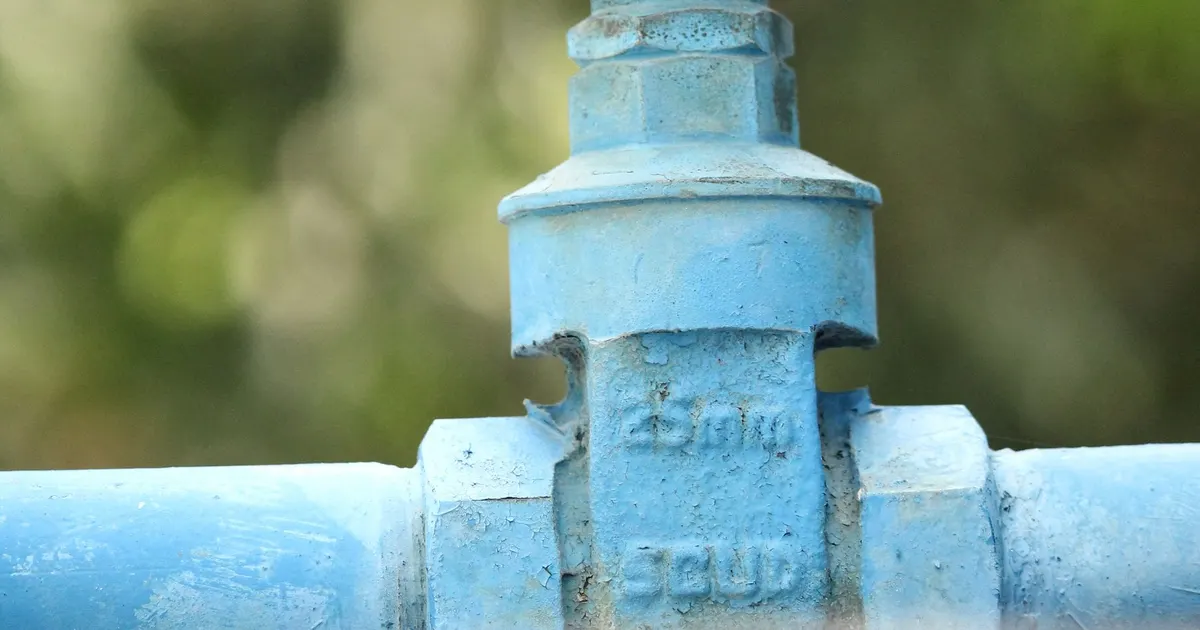
Valve bodies are usually brass, bronze, stainless steel or moulded plastic, but many of the small parts inside them are acetal. Stems, cams, handles, check-valve poppets and seats are common examples. Acetal slides, holds size, resists water and machines cleanly, which suits parts that move in a wet environment. It has limits, and the main ones are chlorine, hot water and approvals.
Typical acetal parts in valves
| Part | Why acetal | What to watch |
|---|---|---|
| Valve stem or spindle | Low friction, stiff, holds thread | Torque, chlorine, creep under preload |
| Valve seat or seat insert | Stiff sealing face, wear resistance | Surface finish, temperature, chemicals |
| Cam and lever | Smooth sliding, quiet | Wear at the contact point |
| Handle or knob | Stiff, easy to colour | UV outdoors, see below |
| Check valve poppet or disc | Stable shape, low friction | Seat finish, flutter, wear |
| Bushing and guide | Low friction without grease | Clearance and swelling |
| Cartridge components | Tight tolerance, good wear | Water quality, deposits |
For bushing and guide design, see the bushing and bearing guide.
Why acetal works in water
- Low water absorption. Acetal takes up little water, so size changes are small. See the water absorption guide.
- Low friction without grease. Stems and cams run smoothly dry or in water.
- Stiffness and creep resistance. Seats keep their shape and sealing force.
- Corrosion free. Unlike metal, there is no rust or scale on the part.
- Machinability. Tight tolerances and fine surface finish are practical.
Where acetal stops working
Chlorine and chloramine
Treated drinking water often contains chlorine or chloramine as a disinfectant, and these can attack acetal. Over time the surface cracks and the part loses strength. Acetal parts in contact with chlorinated water, especially under stress or at higher temperature, have a history of cracking problems. If the part carries load or is in a hot line, check the data.
Hot water
Acetal tolerates warm water, but prolonged exposure to hot water, particularly above about 60 to 80 degrees C, can degrade the homopolymer. Copolymer holds up better. Check the continuous service temperature against the water temperature, as covered in the chemical and temperature guide.
Strong acids and oxidisers
Acids, bleach and strong oxidising cleaners attack acetal. Valves that see cleaning cycles with these agents need another material, such as PTFE, PVDF or a stainless alloy.
Scale and deposits
In hard water, scale can build up on a moving part, and a stem or poppet with tight clearance can seize. Allow clearance and consider surface finish.
Which grade
| Duty | Suggested starting point |
|---|---|
| Cold water, air, mild liquids, mechanical load | Homopolymer, stiff and strong |
| Warm or hot water, alkaline or cleaning solutions | Copolymer |
| Dry sliding with some lubrication need | PTFE-filled acetal, see the filled grades guide |
| Chlorinated drinking water under stress | Compare against other plastics, check data |
| Outdoor handles and knobs | Black or stabilised grade |
See the homopolymer versus copolymer guide for the differences in more detail.
Approvals for water contact
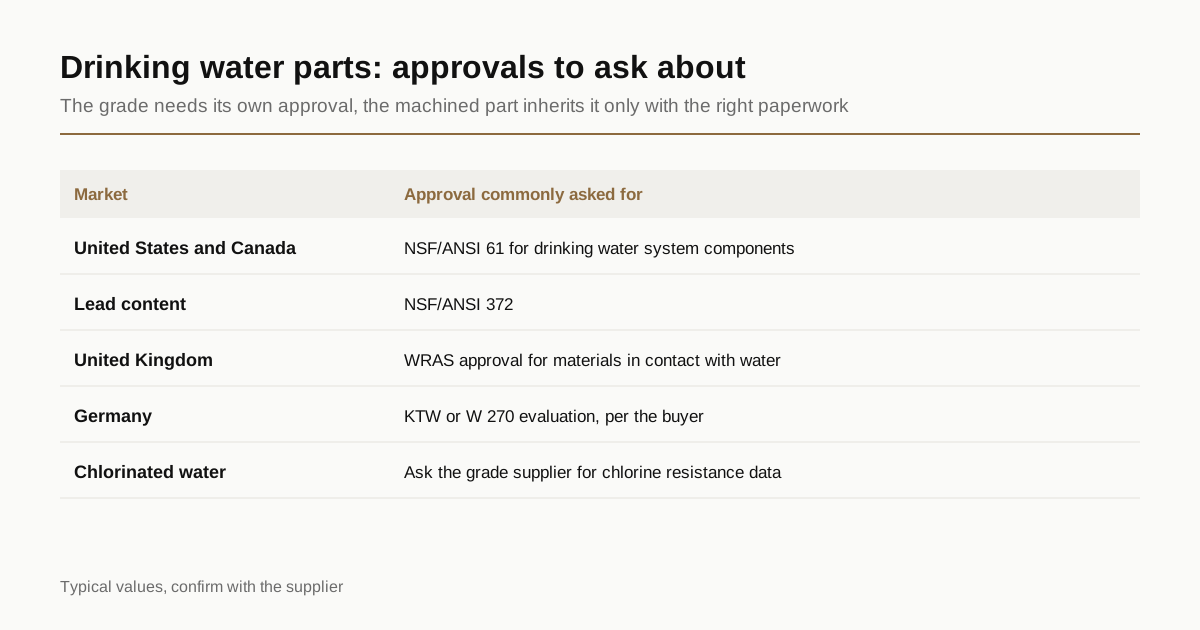
Parts that touch drinking water usually need approvals, and the rules vary by market. The list below shows names that commonly come up, as a pointer only:
| Market | Commonly asked for |
|---|---|
| United States and Canada | NSF/ANSI 61 for drinking water system components |
| Lead content | NSF/ANSI 372 |
| United Kingdom | WRAS approval for materials in contact with water |
| Germany | KTW or W 270 evaluation |
| Elsewhere | Local scheme or an accepted equivalent |
Approval belongs to a specific grade from a specific maker, and a machined part inherits it only when stock and process are documented. Ask the stock supplier for the certificate and keep the lot number linked to the part. A shop cannot make a part compliant by saying so. For other water uses, such as irrigation or industrial water, the approvals may not apply, and the chemistry and temperature are the main concern.
Design points for valve parts
- Seat surfaces. A smooth, flat sealing face with a fine finish seals better. See the surface finish guide. Tool marks across a seat can leak.
- Radii. Sharp corners in stem and cam parts start cracks. Use generous fillets.
- Threads. Plastic threads on a stem carry torque. See the threads guide for engagement and pitch.
- Clearance. Allow for swelling and for temperature change in the housing, which is often metal and moves differently.
- Creep. A preloaded seat relaxes over time. Design for the load after relaxation or use a spring.
- Edges. Deburr thoroughly so loose fragments do not reach the water. See the deburring guide.
Tolerances and testing
Valve parts often need tight fits and a leak-free seat. State critical dimensions and the surface finish of sealing faces on the drawing, using the guidance in the tolerances guide. For production runs, a pressure or leak test on a sample assembly is the real proof, and it belongs to the valve maker. The shop can supply parts with a first article inspection.
Example: designing a seat insert
A common acetal valve part is a ring-shaped seat insert pressed into a metal body. The design questions show how the points above fit together:
| Question | Typical approach |
|---|---|
| What grade? | Copolymer for water, homopolymer for dry gas or oil, both with a stock certificate |
| How is it held? | Press fit with a retaining lip or a rolled edge, since creep loosens a plain press fit over time |
| What finish on the sealing face? | A fine, smooth finish with no cross-lay tool marks, agreed as a value |
| What flatness? | Stated on the sealing face, over the seat diameter, not the whole part |
| What edge? | A small break on the outer edge, a sharp inner edge where it seals |
| How is it tested? | Leak test on the finished assembly, plus a first article on the insert |
The metal body expands less than the plastic, so a press fit that holds at room temperature gets tighter when hot and looser when cold. Check the fit across the working range, using the expansion figure of about 110 micrometres per metre per kelvin. Seats under constant preload relax with time, so design the sealing force with that loss in mind. These points belong in the drawing notes, as in the drawing guide.
Checklist before you request a quote
- State the fluid, temperature and pressure, and whether it contains chlorine.
- Name the approvals required and ask for the stock certificate.
- Choose homopolymer or copolymer, or ask the shop to recommend.
- Mark sealing faces and the finish required.
- Give the quantity and the repeat schedule.
Send the drawing and we match it with up to three shops that machine acetal and reply within 24 business hours.
Frequently asked questions
Is acetal suitable for drinking water valve parts?
It can be, with the right grade and approvals, but chlorine and chloramine in treated water can attack acetal over time. Ask for the grade's drinking water approval and chlorine resistance data, and check the limits for your water temperature.
Which acetal is better for valves, copolymer or homopolymer?
Copolymer is generally the safer choice in water because it resists hot water and alkaline conditions better than homopolymer. Homopolymer is stiffer and a little stronger, so use it where the part sees dry mechanical loads.
What approvals apply to water contact parts?
It depends on the market. Commonly asked for are NSF/ANSI 61 in North America, WRAS in the United Kingdom and KTW or W 270 evaluations in Germany. The approval belongs to the specific grade and sometimes the part, so ask for the certificate.
Need a quote for this part?
Send the drawing. We match you with up to 3 shops that machine acetal and reply within 24 business hours.
Get matched with a Delrin shop