Guides / Design
Acetal Parts for Food Processing Machines: Guides, Scrapers and Change Parts
October 5, 2026
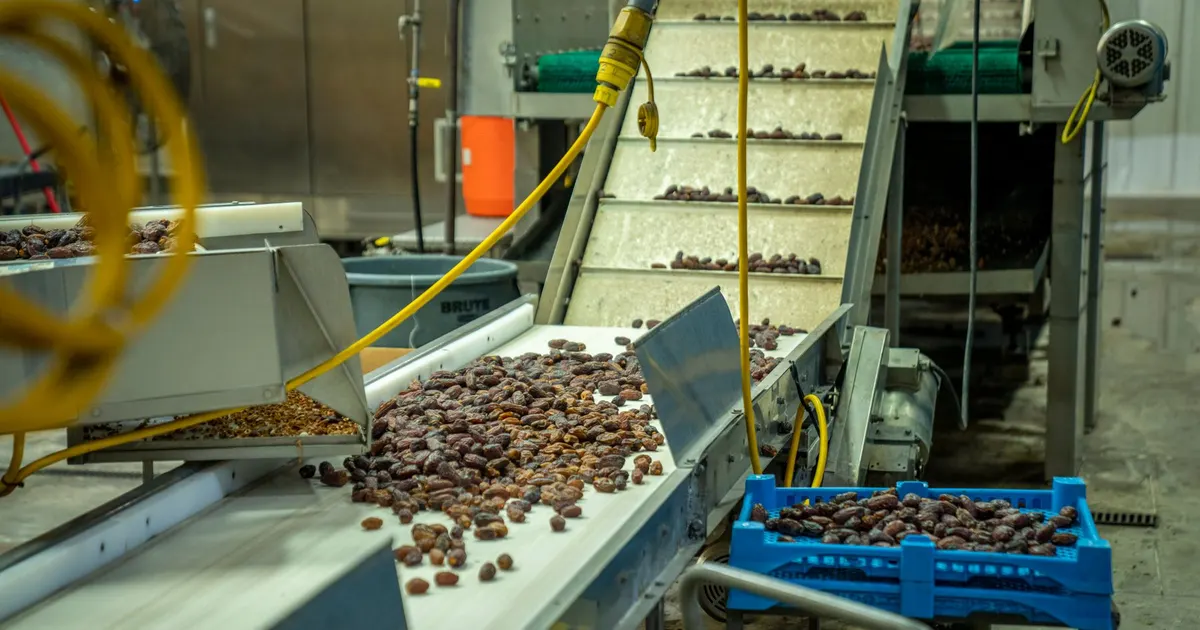
Food processing lines use plastic for the parts that touch product or sit close to it: guides, scrapers, star wheels, rollers, wear strips, bushings and format change parts. They need to run quietly, resist wash-down, avoid trapping product and survive a cleaning regime that would corrode many metals. Acetal is a common choice, and the grade, the paperwork and the shape of the part all matter.
Typical food line parts in acetal
| Part | Role | Notes |
|---|---|---|
| Guide rails and side guides | Position product on a conveyor | Smooth faces, see the wear strips guide |
| Scraper blades | Clear product from belts and drums | Edge condition affects wear on the belt |
| Star wheels and screws | Separate and meter containers | Tight tolerance on pockets |
| Change parts | Adapt a line to a new product size | Made in sets, labelled and colour coded |
| Rollers and idlers | Support belts and webs | See the rollers guide |
| Bushings and gears | Run drives in the splash zone | Low friction without grease |
| Cutting boards and blocks | Backing for knives | Replaceable wear surfaces |
Compliance paperwork to ask for
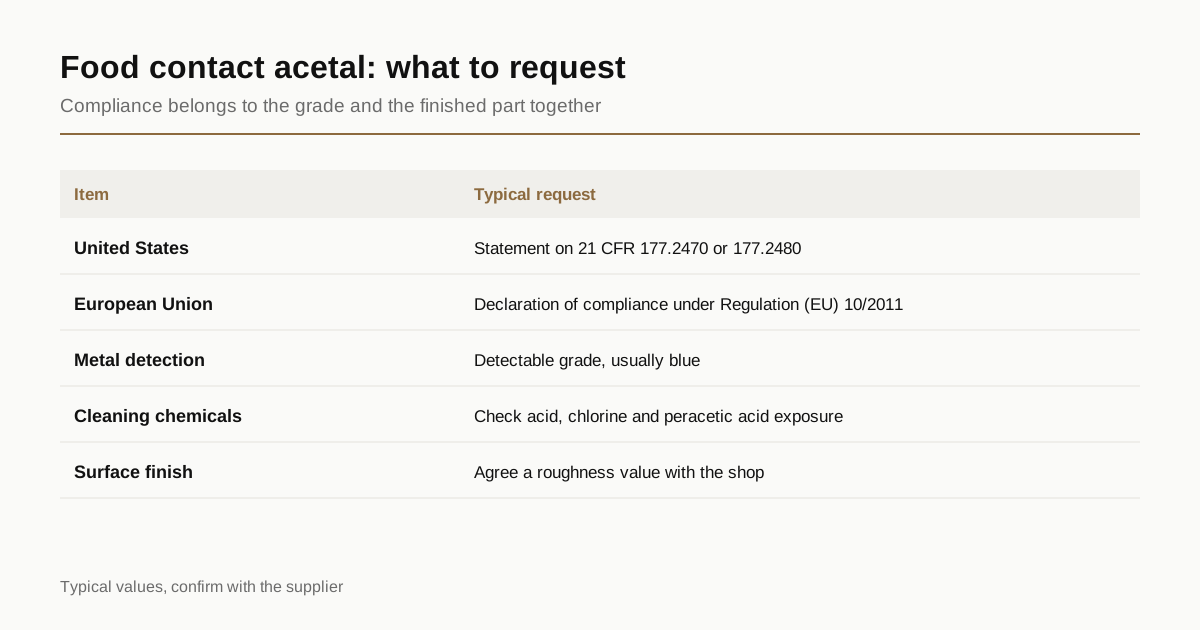
A part that touches food needs materials that are allowed for food contact. The paperwork belongs to the grade and to the finished part:
| Item | Typical request |
|---|---|
| United States | A statement from the resin or stock maker that the grade meets 21 CFR 177.2470 (polyoxymethylene copolymer) or 21 CFR 177.2480 (polyoxymethylene homopolymer), with conditions of use |
| European Union | A declaration of compliance for plastic food contact materials under Regulation (EU) 10/2011, with migration limits and conditions |
| General framework in the EU | Regulation (EC) 1935/2004, which sets the base rules and traceability |
| Metal detection | A detectable grade, usually blue, if the line has metal detectors or X-ray |
| Traceability | Lot number from stock to part, kept for recall needs |
| Colourants and additives | Listed and compliant |
This is a pointer, not legal advice. Rules differ by country and by type of food and temperature of contact. The food grade guide covers detectable grades in detail. A shop that machines the part should use stock with the declaration and avoid cross-contamination with other materials, such as metal chips, coolant with non-food additives and release agents.
Cleaning chemicals and temperature
Food plants clean with a mix of alkaline foam, acid descaler, sanitiser and hot water. Acetal’s tolerance varies:
| Agent | Typical behaviour |
|---|---|
| Alkaline cleaners | Generally good, copolymer is better |
| Neutral detergents | Good |
| Strong mineral acids | Attacks acetal |
| Chlorine-based sanitisers | Can degrade the surface, check concentration |
| Peracetic acid | Check concentration and exposure time |
| Hot water and steam | Limited, particularly for homopolymer |
| Quaternary ammonium sanitisers | Usually acceptable |
Check the exact cleaning chemicals and the temperature, and compare them with the grade data. The chemical resistance guide lists general behaviour. Copolymer is often the better pick for repeated wash-down, as explained in the copolymer versus homopolymer guide.
Hygienic design of the part
A food part has to be cleaned easily, and design affects that:
- Smooth surfaces. Product contact surfaces are often specified with a roughness of Ra 0.8 micrometres or finer in hygienic design guidance, though the right value depends on the application. Agree a value with the shop, as in the surface finish guide.
- Generous inside radii. Sharp internal corners trap product and are hard to clean. Radii of 3 mm or more are a common recommendation.
- No dead pockets. Avoid blind holes and crevices where product can sit.
- Avoid threads in the product zone. Threads trap residue. Use through-bolts with sealed caps or fasteners outside the product zone. See the threads guide if threads are unavoidable.
- Drainage. Slope surfaces so liquid runs off.
- Clean edges. Burrs and fuzz release fragments. See the deburring guide.
- No cracks. Stress cracks are hiding places for bacteria, so avoid sharp notches and heavy interference fits.
Colour, marking and identification
Colour coding of change parts is common, with each product size having its own colour. Natural acetal shows contamination well, while blue acetal serves detection. The black versus natural guide discusses how colour affects inspection. Marking of part numbers should use a method that does not leave loose ink or flakes in the product zone. Laser marking is covered in the laser marking guide, and note that marking depth can create a cleaning trap.
Wear and replacement
Plastic parts in contact with product wear and shed fine particles. A worn scraper or guide should be replaced on a schedule before fragments appear. A spare set of change parts and a wear log reduce risk. Choose a grade that wears slowly against the belt or chain, and make the part so that wear is visible, for example with a thickness gauge groove.
Machining and handling at the shop
- Use stock with the compliance declaration and keep the lot number on the paperwork.
- Use a coolant that is compatible, or machine dry, and wash the finished part.
- Keep acetal separate from metal chips and from other plastics that might contaminate.
- Pack parts in clean, sealed bags with the lot code.
For the questions to ask a shop, see the supplier selection guide.
Inspection and audit trail
Food plants audit their suppliers, and the part’s paperwork matters as much as the part. A short file per order covers most questions:
| Document | Purpose |
|---|---|
| Stock certificate and food contact declaration | Shows the grade and compliance basis |
| Lot trace from stock to part | Supports recall and complaint handling |
| Inspection report | Shows dimensions and surface finish checked |
| Cleaning and packing record | Shows how the part left the shop |
| Drawing revision | Ties the part to the approved design |
Keep these records for the period your quality system requires. When a part changes, for example a new stock source or a new cleaning method, update the file and tell the buyer. A part that passes a visual check but lacks its declaration can still fail an audit. Asking for the file with the first order and again whenever stock changes avoids surprises later.
Checklist before you request a quote
- State the food type, temperature and the cleaning chemicals and their concentrations.
- List the compliance documents required and whether detectable grade is needed.
- Specify the surface finish and radii for product contact faces.
- Mark threads and blind holes, or avoid them.
- Ask for lot traceability and clean packaging.
- Give the quantity and the number of change parts in a set.
Send the drawing and we match it with up to three shops that machine acetal and reply within 24 business hours.
Frequently asked questions
Is acetal food safe?
Specific acetal grades are made for food contact and come with a statement of compliance, but acetal in general is not food safe by default. Ask for the declaration for the exact grade, and keep the lot number tied to the part.
Why are food line plastic parts often blue?
Blue is rare in food, so a blue fragment shows up easily to the eye and to many metal and vision detectors. Detectable grades add a metal or magnetic additive so that metal detectors and X-ray systems can find a lost piece.
Can acetal take cleaning chemicals?
It handles many alkaline and neutral cleaners well. Strong acids, chlorine-based sanitisers and peracetic acid at high concentration can attack it, so check the cleaning agents and concentrations against the grade data.
Need a quote for this part?
Send the drawing. We match you with up to 3 shops that machine acetal and reply within 24 business hours.
Get matched with a Delrin shop