Guides / Design
Acetal Conveyor Wear Strips and Guide Rails: Material Choice, Fixing and Expansion
October 15, 2026
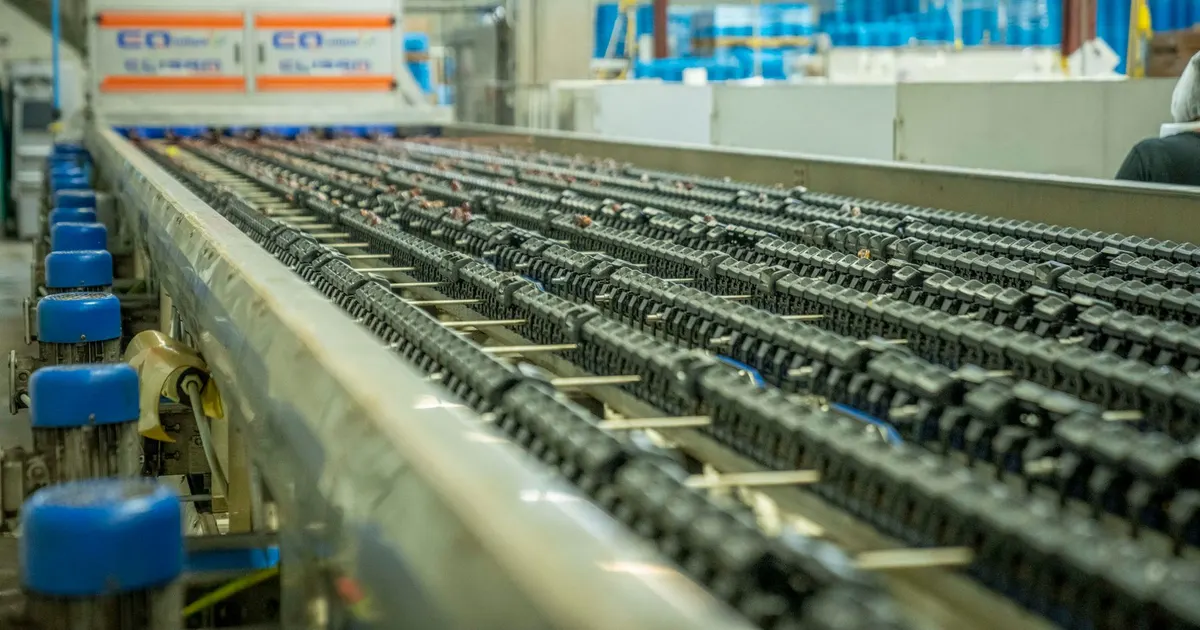
Wear strips and guide rails sit between a moving part and a machine frame. They take the sliding contact that would otherwise wear steel, and they are cheap to replace. Conveyors, packaging lines and machine slides use them everywhere. Acetal is a strong candidate when the strip must be stiff, hold close dimensions or carry load, and UHMW-PE competes where wear and cost matter most.
What a wear strip has to do
A good strip does four things:
- Carries the contact load without deforming.
- Slides with low friction and low noise.
- Wears slowly and evenly, so it can be changed on schedule.
- Protects the metal frame and the moving part.
The sliding partner matters. A steel chain on a plastic strip, a plastic chain on a plastic strip and a belt on a plastic strip each behave differently. The harder and rougher the partner, the faster the strip wears.
Acetal or UHMW
| Factor | Acetal | UHMW-PE |
|---|---|---|
| Stiffness | High | Low |
| Wear against steel chain | Good | Very good |
| Friction | Low | Very low |
| Noise | Low | Lowest |
| Dimensional stability | Good | Poor, large expansion and creep |
| Cost | Moderate | Lower |
| Machining tolerance | Tight possible | Looser, soft and springy |
| Impact | Good | Excellent |
Acetal is the better choice for precision guide rails, narrow strips that must not deflect and strips under heavy point load. UHMW-PE is usually the choice for long chain wear strips with moderate load. See the acetal versus UHMW guide for a fuller comparison. Filled acetal grades can wear better against a hard counterface, as described in the filled grades guide.
Thermal expansion is the main design issue
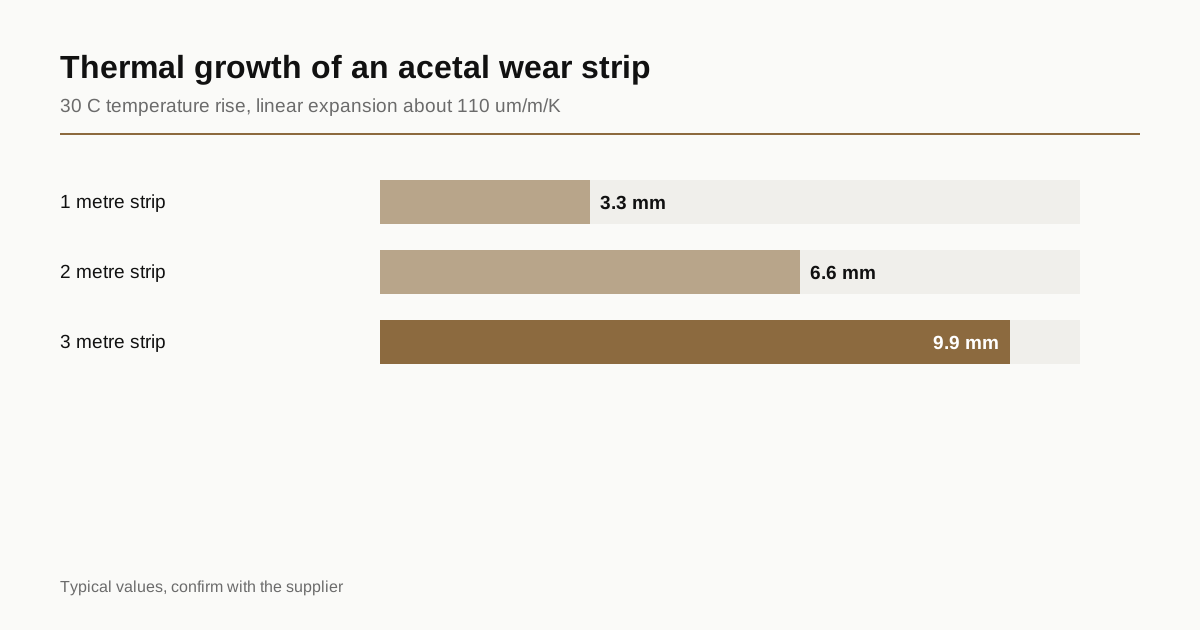
Acetal expands about 110 micrometres per metre per kelvin. For a strip, the growth is length times that coefficient times the temperature change.
| Strip length | 20 C rise | 30 C rise | 50 C rise |
|---|---|---|---|
| 1 m | 2.2 mm | 3.3 mm | 5.5 mm |
| 2 m | 4.4 mm | 6.6 mm | 11.0 mm |
| 3 m | 6.6 mm | 9.9 mm | 16.5 mm |
A steel frame grows about nine times less, so the strip grows relative to the frame. A strip fixed at every hole has nowhere to go, so it buckles, lifts or shears the fixings. A strip that is cold when installed and warm in service pushes into any neighbour with no gap.
Fixing the strip
Good practice follows a few rules:
- Fix at one point only. Use one tight hole near the centre or one end, and make every other hole a slot along the length.
- Slot length. Size slots for the expected growth in each direction, plus a margin.
- Countersunk screws. The head must sit below the wear surface with room to spare, so wear never reaches the screw. A flat-head screw in a countersink is common, and a counterbore with a plug is another route.
- Screw spacing. About every 100 to 200 mm for most strips, closer for thin ones.
- Gaps between sections. Leave a small gap at joints, and stagger joints against joints in the chain or belt.
- Edges. Keep the chain or belt from catching on a joint by chamfering ends and aligning faces.
A cross-section view of the slot and the screw shows the slot length and the countersink depth on a drawing. Threads for retaining screws are covered in the threads guide, though most strips use through holes and nuts or threaded holes in the metal frame.
Profile and lead-in
| Feature | Purpose |
|---|---|
| Chamfered or radiused entry end | Lets chain or belt ride onto the strip without catching |
| Chamfered edges | Avoids snagging and reduces chipping |
| Raised rib or flange | Keeps the chain in place, acting as a side guide |
| Flat bottom face | Sits flush on the frame, no rocking |
| Constant thickness | Even wear, easy replacement |
| Wear indicator groove | Shows when the strip is worn to the replacement point |
For guide rails, the contact face is smooth and straight, and the tolerance on width sets the product clearance. A guide rail for a bottle or a box often needs a tolerance of a few tenths of a millimetre. State the straightness along the length on the drawing, and see the tolerances guide.
Wear life and load
Wear depends on contact pressure, speed, temperature, lubrication and contamination. Dust, grit and hard debris wear any plastic quickly. A strip that runs dry against a clean steel chain at low speed lasts far longer than one in an abrasive environment. Ways to extend life:
- Spread the load with a wider strip.
- Keep the counterface smooth and free of burrs.
- Add a little lubrication where the process allows it.
- Use a filled or harder grade where abrasion is the issue.
- Plan inspection. Measure thickness at set intervals and replace before the fixings are exposed.
Data sheet wear figures are comparisons, not predictions. For bearings and sliding parts in general, see the bushing and bearing guide.
Machining long strips
Strips cut from sheet or bar keep their shape better when machined with care:
- Sheet is cut to blank width first, using one of the methods in the cutting sheet guide.
- A long, thin strip can bow when one face is machined, so hold it evenly and machine both faces. The flatness guide explains the sequence.
- Slots and countersinks are milled in one setup for accurate spacing.
- Strips of several metres need a long table or are made in sections.
Food and washdown lines
Strips on food lines need a grade suited to food contact, and may need metal detectability. See the food machinery guide and the food grade guide. Wash-down chemicals and hot water affect the choice between acetal and UHMW-PE.
Planning replacement
A wear strip is a consumable, and the machine should be designed to change it quickly. Plan three things at the start. First, access: the strip should come out with a few screws and without dismantling the line. Second, a wear limit: mark a thickness or a groove depth at which the strip is replaced, and write it into the maintenance plan. Third, spares: keep a set in stock and make replacement strips to the same drawing revision so that the fit is the same each time. Order replacements in sets, because strips from one lot wear alike.
Checklist before you request a quote
- Give the length, width, thickness and the fixing pattern.
- State what slides on the strip and at what speed and load.
- Give the temperature range so slots can be sized.
- Specify the grade, colour and any food-contact need.
- Mark lead-in chamfers, side ribs and wear indicators.
- State quantity and whether a long run is made in sections.
Send the drawing and we match it with up to three shops that machine acetal and reply within 24 business hours.
Frequently asked questions
Should a wear strip be acetal or UHMW?
UHMW-PE is cheaper, quieter and very wear resistant against chain, so it is the usual first choice for long chain strips. Acetal is stiffer, holds its shape under load and gives tighter guide tolerances, so it suits guide rails, loaded strips and precision tracks.
How do you fix a plastic wear strip so it does not buckle?
Use countersunk screws in slotted holes, fixed rigidly at one point only, so the strip can grow and shrink along its length with temperature. A strip pinned at every hole will bow or shear the fixings when it warms up.
How long can a wear strip be?
Strips are commonly made in lengths up to a few metres, but thermal growth rises with length. Long runs are often built from shorter sections with small gaps, staggered against any joints in the chain path.
Need a quote for this part?
Send the drawing. We match you with up to 3 shops that machine acetal and reply within 24 business hours.
Get matched with a Delrin shop